Understanding Financial Instruments in SAP TRM: Concepts, Types & Business Processes
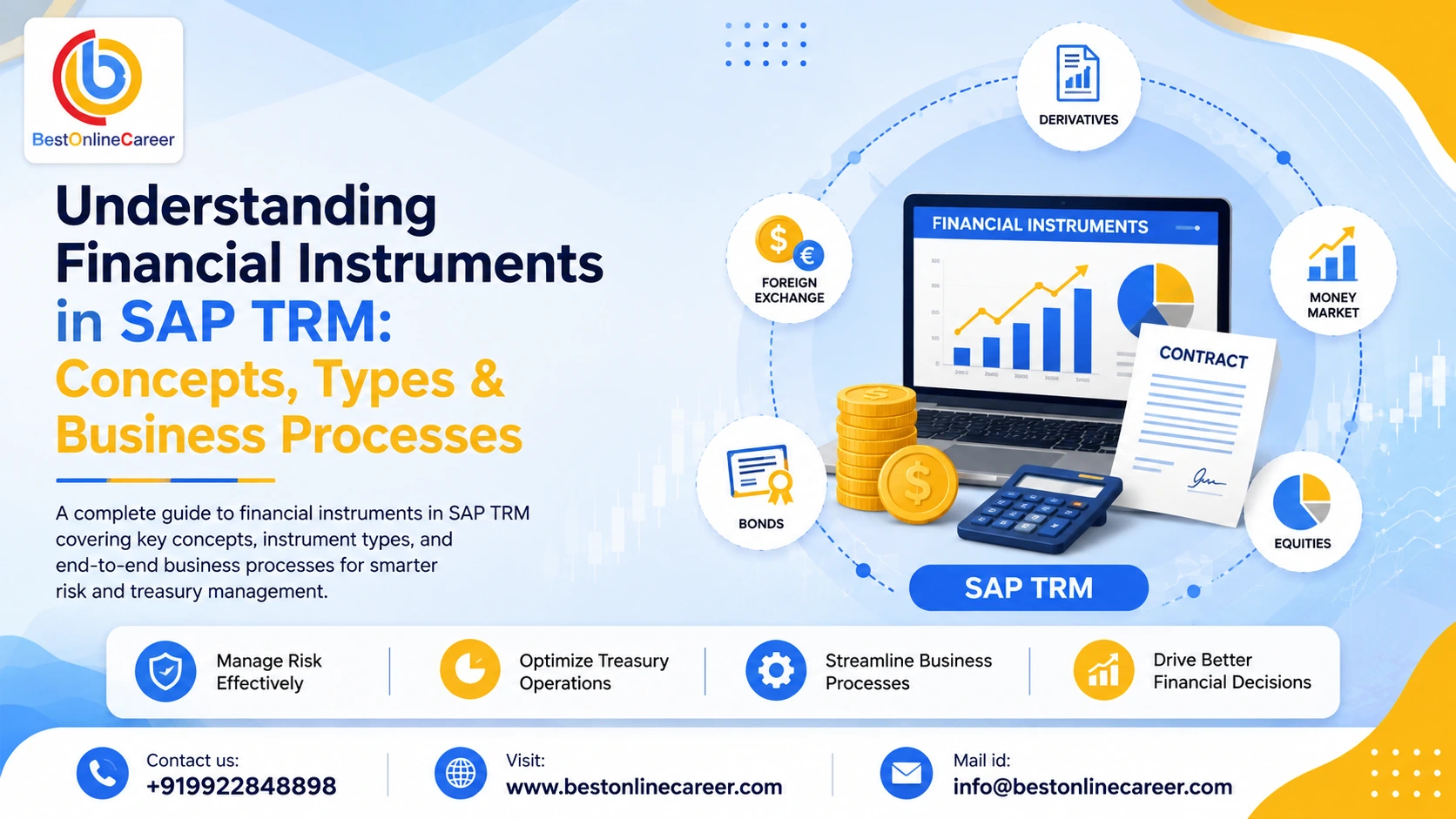
Understanding Financial Instruments in SAP TRM: Concepts, Types & Business Processes
What Are Financial Instruments in SAP Treasury and Risk Management (SAP TRM)?
Financial instruments within SAP TRM is the functional and digital representation of actual financial contracts that businesses are required to sign in their daily treasury activities. Financial instruments, in its simple sense, refers to any arrangement that generates an asset in one person and the financial obligation or equity instrument in the name of another. It could be as straightforward as a fixed deposit at a bank or as complicated as the multi-currency interest rate swap.
SAP Treasury and Risk Management is designed specifically to manage the entire range of these instruments in an integrated, single environment. Instead of treasury departments relying on spreadsheets, emails or other systems that are not connected, SAP TRM consolidates every transaction onto one platform, where it can be crafted, tracked, evaluated and analyzed in a consistent manner.
The system is largely divided into functional areas like Transaction Manager and Position Manager and Risk Manager, each of which is a key element in how the financial instrument is processed:
- Transaction Manager handles the actual transaction capture -- recording the name of the counterparty and what the instrument's type is, the value of currency, dates, and the amount associated
- Position Manager tracks the ongoing condition of the instrument such as its value at present as well as accrued interest and any modifications over time
- Risk Manager analyzes the risk caused by the instrument for the degree of sensitivity to changes in currency or interest rate fluctuations
Because financial instruments can differ greatly in terms of the degree of complexity, SAP TRM organizes them into distinct categories of products, each with distinct rules as well as valuation logic and reporting needs. This approach to structure allows large companies to handle thousands of transactions in different currencies and markets without losing control or accuracy.
In the end, financial instruments in SAP TRM aren't simply data entries; they are actual financial commitments, which carry risk as well as generate cost or returns and directly affect the balance sheet of an organization as well as its cash position. This is why so many treasury and risk management teams treat SAP TRM as the single source of truth for every financial instrument in their portfolio.
Why Financial Instruments Are Essential for Treasury Operations
Treasury operations are designed to ensure that a business always has the appropriate amount of cash, in the correct currency at the right moment -- while safeguarding the company from risks that it is unable to manage, like the impact of exchange rate or interest rate changes. These instruments provide real tools used by treasury departments to accomplish this. Here's a closer understanding of why they are needed in the first place:
- Controlling Liquidity: Each business has periods of excess cash as well as periods of cash shortfalls. Instruments like fixed deposits, commercial papers, and short-term loans allow treasury teams to store excess funds in a productive manner or get quick funds in times of need, which ensures the smooth running of day-to-day activities.
- Risk Mitigation: Businesses that operate in international locations or that have to deal with fluctuating rates of interest face constantly exposing themselves to market changes. Instruments like futures contracts, options and swaps function as security instruments, locking prices or rates in advance to ensure that sudden market movements don't impact profits.
- Accurate Forecasting of Financial Events: With live information about all financial instruments, treasury teams can predict future cash flows and outflows with greater accuracy. This aids in planning investment in the future, debt repayments, as well as working capital requirements ahead of time.
- Accounting and Regulatory Compliance: Financial instruments have to be reported in accordance with strict accounting standards like IFRS 9 or US GAAP. SAP TRM ensures that every instrument is evaluated and reported in a timely manner, thus reducing the chance of audit and compliance problems.
- Affirmative Decision-Making: If treasury managers have full visibility into the performance as well as its maturity and risk profile, they are able to make better strategic decisions whether it's renegotiating loans, closing an unwise derivative position or shifting the investments.
Without a dedicated system in place to manage these instruments, treasury departments are likely to struggle with data fragmentation or manual errors and a slow reporting process -- all of which could cause poor financial decisions, as well as increased risks for organizations. This is exactly the gap that SAP Treasury and Risk Management is built to close.
Core Components of Financial Instruments in SAP TRM
Each financial instrument that is processed by SAP TRM is based on an array of fundamental components that work in tandem to ensure completeness and accuracy throughout its entire life. Understanding these components will help to understand how the system functions behind the scenes.
| Component | Description |
|---|---|
| Transaction Data | Primary element of any financial instrument. It includes information about the type of instrument used, the counterparty, the date of trade and the date of value and the amount principal, currency used and any rate of interest or pricing phrases. Accurate transaction information is essential as every subsequent step -- such as accounting, valuation and reporting -- is dependent on it. |
| Position Management | When a transaction is completed, the transaction creates a "position" within the system. The position is the company's current position or obligations associated with the instrument. The management of positions involves monitoring any changes to the holding, including the accrual of interest, changes in market value, as well as any rollovers, partial or complete settlements. |
| Valuation and Accounting | SAP TRM automatically calculates the fair value of any instrument, based on the most recent market data, current interest rates along with exchange rates. This value is directly fed into the accounting records of the company, making sure that profit and loss, along with the balance sheet numbers, reflect the actual financial situation at any time. |
| Risk Analysis | Each financial instrument is subject to a degree of risk, whether it's market risk (from rate or price fluctuations), credit risk (from default by the counterparty), or liquidity risk (from an inability to end an investment quickly). SAP TRM's risk assessment tools constantly examine these risks, and give treasury teams early warning of possible issues. |
| Reporting and Compliance | Each instrument has to be disclosed both internally (for reviews of management) as well as externally (for auditors, regulators, and other stakeholders). SAP TRM automates much of the reporting process, and produces standard outputs that conform to accounting guidelines and internal governance policies. |
Together, these five elements create a continuous cycle that begins when the transaction is made and will continue until the instrument is completely settled or matured -- reinforcing why financial instruments in SAP TRM need to be tracked with precision at every stage.
Types of Financial Instruments Supported in SAP TRM
SAP TRM is built to manage a variety of financial instruments, all of which serve an individual purpose in the treasury function. Here is a more thorough overview of the most important types:
| Instrument Type | Purpose & Examples |
|---|---|
| Money Market Instruments | Financial products for short-term use which typically mature within a year. They are utilized primarily to manage day-to-day liquidity. They include commercial papers, treasury bills, and call money. They're generally safe and extremely liquid, which makes them the perfect vehicle to store excess funds for a short period of time. |
| Foreign Exchange Instruments | These instruments assist organizations in managing the risk of dealing with multiple currencies. They include spot transactions (immediate exchange of currency) as well as forward contracts (agreements to exchange currencies at an unspecified date at a set rate) and swaps for currency (exchanging principal and interest-paying transactions in various currencies). |
| Securities and Investments | This class includes longer-term instruments like bonds, equities, mutual funds, as well as government securities. They are usually used to earn yields over a longer time frame and usually require more precise accounting and valuation procedures because of their complex nature and sensitivity to market. |
| Derivatives and Hedging Instruments | The value of derivatives is derived from an asset that is the basis for their value, like an interest rate or currency price. Examples include the interest rate swap, futures options, and the forward rate agreement. They are typically utilized for hedges to protect the company from price fluctuations that could be detrimental, and not for investment-related purposes directly. |
| Loans and Borrowings | A broad category that includes both short-term as well as long-term debt instruments which companies utilize for raising funds. They could be bonds, bank loans, or loans made by a company or intercompany loans, each with their own interest obligations and repayment timetables. |
Each one of these types of financial instruments is handled by a distinct module within SAP TRM that implements specific rules for risk assessment, valuation and accounting treatment in accordance with the particular characteristics of the instrument type.
End-to-End Business Process of Financial Instruments in SAP TRM
The path of a financial instrument through SAP TRM follows a well-defined and structured procedure. This ensures accuracy, consistency and control at each step. Here's a more thorough analysis of each step:
| Stage | What Happens |
|---|---|
| Trade Initiation | The process starts when a requirement for business arises, be it using cash to invest, securing short-term funds, or the ability to hedge against a currency risk. Treasury teams will determine the most appropriate instrument type based on the demand. |
| Deal Capture | After the instrument type has been selected, the details of the transaction are entered into SAP TRM. This includes information about the counterparty and the amount, as well as the currency and interest rate, as well as price, as well as the pertinent dates. Achieving accuracy at this point is vital, since it is the foundation for any subsequent processing. |
| Validation and Approval | Prior to a transaction becoming active, it usually goes through an approval and validation process. This makes sure that the transaction conforms to internal guidelines, credit limits, and authorization limits, thereby reducing the chance of fraudulent or erroneous transactions. |
| Position Update | Once the transaction is approved, it will update the treasury position of the business in real-time. This provides treasury executives with an immediate and accurate picture of the overall financial exposure to all instruments. |
| Valuation | On a regular basis, typically monthly or daily based on the instrument, SAP TRM recalculates the market value of each investment. The calculation includes interest accrued as well as foreign exchange gains and losses, as well as fair value adjustments based upon the current market rate. |
| Settlement | At the time of the value date, the actual payment or receipt that is associated with an instrument will be processed. SAP TRM manages this settlement process, making sure that cash movements are properly recorded and compared against bank statements. |
| Reporting | Once the transaction is completed or has reached an agreed-upon reporting threshold, SAP TRM generates the required reports to be used for compliance, accounting and management review. These reports give a clear view of the financial health of the company and make sure that all applicable regulations regarding disclosure are being met. |
This process is designed to ensure that each financial instrument -- regardless of the degree of complexity -- is handled in the same manner with equal discipline and precision, starting from the time it's first initiated to the final settlement. It's a core part of how SAP Treasury and Risk Management supports day-to-day treasury operations.
Money Market Transactions
Money market transactions are the foundation of short-term management of liquidity within any treasury service. They are usually instruments that last from overnight to a year. They are designed to assist companies to either invest money that is not being used or borrow money for shorter time frames.
The most common types of money market transactions comprise:
- Fixed Deposit: A lump-sum amount that is put in the bank for a predetermined time period at a fixed rate
- Commercial Papers: Short-term, unsecured promissory notes issued by businesses to fund their operations
- Certificates of Deposit: Made by banks, which carry a fixed interest rate and expiration date
- Notice and Call Money: A very short-term loan or lending, typically for as little as a day
In SAP TRM these transactions are logged with exact details, such as an interest rate as well as beginning and end dates, as well as details about the counterparties. The system automatically calculates the interest rate over the course of the instrument, and then updates the treasury's liquidity position in line with it. This allows the treasury team to make quick, educated decisions on where to invest the funds that are surplus or to fill short-term funding gaps in the most cost-effective way.
Foreign Exchange (Forex) Transactions
The exchange of foreign currency is vital for any business that is international or operates in different currencies. The value of currencies fluctuates constantly because of market forces, and if they are not managed properly, these fluctuations can greatly impact the profitability of an organization.
The principal types of foreign exchange transactions that are supported by SAP TRM are:
- Spot Transactions: These involve the instant exchange of one currency to another, usually completed within two working days. Spot transactions are employed for companies that require immediate currency, like for an imminent payment.
- Forward Contracts: They allow businesses to lock in an exchange rate now for an event that is expected to be completed at a later date. This is especially beneficial for companies that are aware they'll need to pay or receive a currency exchange payment in the near future, and want to safeguard themselves against unfavorable rates.
- Currency Swaps: They involve trading both the principal as well as interest of loans in one currency for comparable amounts in a different currency. Swaps are frequently employed by multinational corporations to manage their long-term exposure to currency across multiple markets.
Securities and Investment Transactions
SAP TRM continuously tracks exchange rate fluctuations and automatically revalues open positions in forex, providing treasury teams a real-time view of the possibility of losses or gains. This proactive monitoring allows businesses to adopt timely actions, like closing a position or changing a hedge, prior to currency volatility causing substantial financial damage.
Securities and investment transactions are the long-term aspect of treasury management. They are focused on earning profits from surplus funds, instead of merely preserving liquidity. These types of instruments usually have more potential for return, but also more risk than other instruments in the money market.
| Security Type | Description |
|---|---|
| Bonds | Securities issued by companies or governments with fixed or variable interest rates over a predetermined time |
| Equity | Ownership shares of the company, that can offer capital appreciation as well as dividend income |
| Mutual Funds | Pools of investment vehicles that provide diversification across various securities |
| Government Securities | Low-risk instruments issued by government entities, typically used to fund steady, long-term investments |
SAP TRM manages the complete duration of these investments, beginning from the purchase of the first investment, through the ongoing valuation process as well as revenue recognition (such as dividends or interest), and finally, selling or reaching maturity. Since securities are affected by market fluctuations, the valuation engine of the system plays an important part in ensuring that the investment portfolio of an organization is always accurately represented in the financial statements.
Derivatives and Hedging Instruments
Derivatives are among the more complicated financial instruments that are managed in SAP TRM, principally because their value isn't fixed, but rather derived from an asset that is the base of their value, such as an interest rate or currency price. Most companies use derivatives not for speculative investments, but instead as tools to control risk.
Common derivative instruments include:
- Interest Rate Swaps: Contracts to swap fixed rate payments in exchange for floating rate (or reverse), aiding organizations in managing the risk of interest rate fluctuations
- Options: Contracts which grant the owner the right, without obligation, to purchase or sell an asset for a predetermined price within a specified timeframe
- Contracts for Futures: Standardized agreements that require the sale, purchase, or transfer of assets at a specified price at a future date
- Forward Rate Agreements: Contracts that secure the interest rates for a later time, protecting against rate changes
One of the most important aspects that is managed in SAP TRM concerns hedge accounting. When a derivative is employed specifically to mitigate risk from an additional financial position, the system needs to be able to document and prove the efficiency of this hedge arrangement in order to ensure compliance with accounting guidelines. SAP TRM provides dedicated tools to monitor and test the hedge's effectiveness, and ensure that the gains and losses of the derivative are correctly in line with the risk the derivative is protecting.
Best Practices for Managing Financial Instruments in SAP TRM
To maximize the value from SAP TRM and to ensure the proper management of financial instruments, companies should follow these best practices:
- Maintain Accurate Master Data: Check that your counterparty's details, such as currency codes, currency types and configurations of instruments, are accurate and current, as errors in this area can lead to issues with reporting and valuation.
- Maintain a Regular Update of Market Data: As the value of an instrument is heavily dependent on the rate of interest in addition to exchange rates, it's crucial to feed the system up-to-date and accurate market information via automatic feeds or manual updates.
- Implement a Strong Approval Workflow: Set specific authorization levels for various kinds of transactions and their size, thus reducing the chance of fraudulent or illegal transactions being entered into the system.
- Conduct Regular Reconciliation: Frequently reconcile the positions of treasury within SAP TRM to general ledger balances as well as bank statements to spot discrepancies in time.
- Monitor Risk Continually: Make use of SAP TRM's risk analysis to monitor exposure levels across interest rates, currencies and counterparties, instead of only relying on periodic review.
- Team Training: Ensure that treasury employees are properly trained, not just on how to utilize the software, but about the latest accounting standards and regulations that impact the way instruments are reported and processed.
- Document Hedge Relationships Clearly: For any derivative utilized for hedging, keep detailed records of the hedge plan and effectiveness tests, ready for audits.
Implementing these guidelines helps companies reduce operational risk, maintain compliance, and ensure that SAP TRM continues to deliver accurate and reliable data about the financial condition of the company.
Financial instruments form the backbone of effective treasury management, and SAP TRM provides a comprehensive, integrated platform that can manage the entire lifecycle of these instruments -- beginning from the moment the trade is made until its final settlement and reporting. By gaining a better understanding of the various kinds of financial instruments, their primary elements, and the business processes involved, businesses can improve their control of liquidity, reduce financial risk, and achieve better decision-making throughout their treasury operations. If you'd like to receive regular updates, practical advice and thorough walkthroughs of SAP TRM concepts, join our WhatsApp Channel to stay connected and stay up-to-date with the latest information.
Related SAP Training Courses
Tags
Share this article
Help others discover this valuable SAP content