
What Is SAP Fieldglass and How Does It Work?
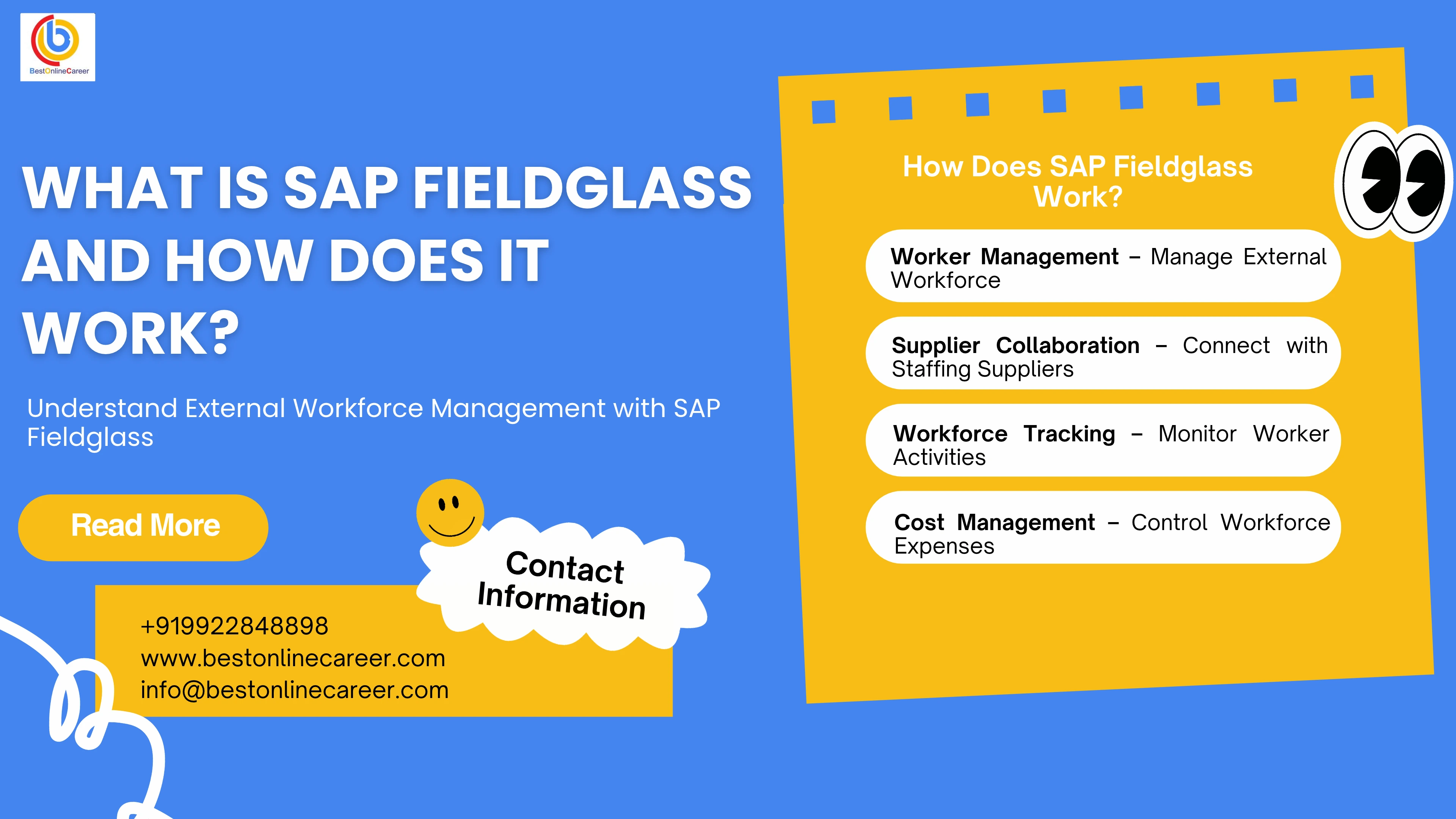
SAP Fieldglass: What Is It? How Does It Work?
Every growing business relies on people not on their payroll. Freelancers, consultants, temps, agency workers, independent contractors and other project-based service providers can fill skill gaps, manage seasonal demands, and keep important projects moving. In many large organizations this external workforce represents a large proportion of the people doing the work, in some industries close to half. Until a few years ago, most companies saw these workers as a minor side issue. Today they are a mainstay of how business is done.
The problem is that managing that many people by emails, spreadsheets, paper timesheets and separate vendor contracts quickly becomes confusing, expensive and risky. Who is working for us these days? What are we paying them for? Did they sign the right contract?” Did anyone check out their credentials? Are we paying invoices that are what was agreed upon? These questions are difficult to answer without a proper system and mistakes can cost a great deal of money. This is the problem that SAP Fieldglass
, a leading contingent workforce management solution, was created to solve.
SAP Fieldglass is a cloud-based vendor management system (often called a VMS) built for contingent workforce management, which allows companies to find, hire, manage and pay their external workforce through one central platform. Thus, This encompasses the entire process from initial worker or service request through to payment. In this blog we will see what SAP Fieldglass is and how it works from the start till the end. We will also see how each major feature works with real business situations and why so many enterprises depend on it.
What is SAP Fieldglass and how does it help with workforce management?
SAP Fieldglass was an independent company that specialized in external workforce technology before being acquired by SAP and integrated into its broader business software portfolio. Today, it is one of the best-known platforms in the world for external workforce management and services sourcing, and is used by large companies in industries ranging from manufacturing to banking, healthcare, energy, telecommunications, retail and technology.
To see its role, think about how a company handles its permanent employees. There’s a structured hiring process, an onboarding process, a way to track working hours, a payroll system, performance reviews and a clear set of compliance rules. Most companies have good tools for all of this, typically within an HR system. But for contingent workers and service providers, the process is usually scattered across departments. A manager uses a personal contact to hire a freelancer. Another is with a staffing agency on a different contract. Procurement signs a services contract no one in HR ever sees. Finance receives invoices from dozens of vendors in different formats and has to guess which ones are correct.
That means poor visibility and poor control. Leaders often can’t answer basic questions — such as how many external workers are active today, how much is being spent on external workers, which suppliers are providing the best value, or whether everyone is compliant. The lack of clarity is not just an inconvenience. It creates financial waste, legal exposure and operations risk.
SAP Fieldglass puts it all together in one system. Hiring managers, procurement teams, HR, finance, staffing suppliers and the workers themselves all use the same platform but each have their own role and permissions. It becomes a single source of truth for all external workforce things. When a manager creates a request, the supplier can see it. When a supplier provides a candidate, the manager will see it. The worker submits a timesheet, the manager approves the timesheet and finance sees the result. “Everyone is working off of the same information at the same time.
The platform generally includes two broad classes of external labor. The first group includes contingent or temporary workers, who are typically paid by the hour or day through staffing suppliers and are under the control of the company’s managers. The second is services-based work, where the vendor delivers a project or outcome based on a statement of work and the company pays for deliverables or milestones rather than hours worked. Fieldglass does both, which is a benefit for companies that have a mix of staffing and project-based engagements. Some organizations use it to manage independent contractors and freelancers directly, as well as those who come through staffing agencies.
Another key point is that Fieldglass is cloud-based. This means that companies don’t need to install heavy software on their own servers. Users log in via a web browser, the provider pushes updates and teams in different countries can use the system at the same time. This is especially helpful for multinational companies that want one process that works consistently across multiple regions but still allows for local rules and requirements.
SAP Fieldglass Working Step by Step
The easiest way to understand Fieldglass is to follow the life of an external worker engagement from start to finish. Of course, every company configures the system differently, but generally the flow is the same.
It begins when there is a business need. A manager realizes the team could use a little help, maybe a developer for six months or an administrative assistant for a busy quarter. The manager submits a request in Fieldglass detailing the role, skills needed, location, duration and budget. This request may require approval by finance or a department head, and the system automatically routes it to the right people based on rules that the company has set up.
Once the request is approved, it is sent to the company’s approved staffing suppliers. These suppliers go through the requirements and suggest candidate profiles through the platform. The hiring manager compares candidates, schedules interviews and chooses the best fit. Once selected, a work order is created that includes the agreed rate, start date, end date and other terms. This is the formal record of the engagement and everything that follows (timesheets, invoices etc) is tied back to it.
Then there’s onboarding which includes the checks and paperwork needed before the worker starts. Then the real work begins. The worker registers their time in the engagement, expenses are entered and approved by managers and invoices are created. If the engagement needs to be extended, altered or ended early, these changes are handled in the same system, with approvals and a clear record. After the engagement is over, the worker is off boarded, access to system and building is removed and the data remains in the platform for reporting and audit purposes.
It is worth noting what this flow does. Every step is traced, every decision is claimed, and every cost is tied to an approved agreement. Nothing of importance happens outside the system. That’s the essence of Fieldglass as a workforce management software platform, and each step is explained in more detail below.
Create and Manage Job Postings and Requisitions
It starts with the job posting and requisition management. A hiring manager posts a job into Fieldglass that outlines what the company needs. This information includes job title, the description of the duties to be performed, the skills required, the experience level, the work location, the expected duration, the number of positions and the pay rate or range of rates.
Many companies have templates so managers don’t have to start from scratch every time. For example, a template for an IT support analyst can already contain the standard description, the usual skill requirements and the approved rate range. It standardizes requests across departments and ensures that important details are never missed. It also saves a lot of time, as most managers only need to change a couple of fields.
There are built in approval workflows as well. Depending on budget, department, location or type of role, a request might go through several levels of approval. A low-cost, short-term role may only need one manager’s approval, but a high-cost, long-term consultant might require a director and the finance team to sign off. This allows companies to better control spending before they even hire a single person, rather than finding out the cost after the fact.
Once the job posting is approved it is sent to suppliers. "They can send it to all their approved suppliers at the same time, or to a selected group, and they can put rules in about how quickly suppliers have to respond. Some firms issue requests in stages, first offering them to preferred suppliers, then to a wider group if no suitable candidates are found. Suppliers enter candidates directly into the system, and the hiring manager sees them side by side, looking at skills, experience, proposed rates and availability.
It is much quicker and neater than collecting CVs via email and it provides a clear audit trail of who was considered and why a certain candidate was chosen. That record is useful for fairness, for internal audits and for improving future hiring decisions. Once a candidate is selected the system creates a work order confirming the details of the engagement. This forms the basis for all that follows.
Timesheet and expense management
Tracking time and expenses becomes another regular task as soon as a worker starts working. For many organizations, this is one of the most laborious and error-prone aspects of managing a contingent workforce, often reliant on paper forms, emailed spreadsheets or manual input by overworked administrators. Mistakes here will translate directly into overpayments, underpayments and conflicts with suppliers.
So workers put in time sheets electronically in Fieldglass recording the hours or days worked against the work order. The timesheet is then routed to the appropriate manager for review and approval. Managers can see exactly what was submitted, compare it to the agreed terms of the work order, and approve or reject it with comments. If something looks wrong, the manager can send it back to be fixed, rather than green lighting it and fixing the problem down the line.
Rules can be created to automatically flag unusual entries. For example, if an employee submits hours that exceed the agreed upon weekly limit, or requests overtime that was not approved, the system can alert the approver, or halt the submission until it is reviewed. You can also manage different rate types like regular time, overtime, weekend rates or special shift pay so that each hour is billed at the right rate.
Costs are about the same. Workers can enter expenses with supporting details and receipts for any travel or materials purchased for the project, and they go through the same approval process. Companies can set rules and limits on expenses so the system can identify claims that do not meet the rules. Everything is tied to the original work order so it is easy to check to make sure the charges are in line with what was agreed upon.
Approved timesheets and expenses flow directly into invoicing. Instead of suppliers sending invoices for manual checking against the record, the system can produce invoices from approved data. In many cases invoices are consolidated, so that Finance receives one organized invoice, rather than many separate invoices. This reduces billing disputes, speeds payment, reduces the workload on accounts payable and gives finance teams much more confidence in the numbers they are paying.”
Management of Statement of Work (SOW)
Ready to Start Your Learning Journey?
Join thousands of learners and build your future with expert-led courses and 100% practical training.
Expert Guidance
Learn from industry experts
Trusted & Recognized
Top-rated by learners
Flexible Learning
Online options
Placement Support
Career support & more
Not all outside work is hiring people. Many companies purchase outcomes such as a website redesign, a software implementation, a marketing campaign, a research study or a facility maintenance contract. Typically, these engagements are governed by a statement of work that specifies what will be delivered, when it will be delivered, and at what price. This model is less worried about how many hours a person puts in and more worried about whether the promised result is delivered.
This type of service procurement is supported by Fieldglass. The company can then create a SOW in the system, define the scope of work, set milestones and deliverables, and agree on payment terms with the vendor. The vendor can then respond, negotiate and close the terms on the same platform. It can support different pricing models, for example fixed price, payment per milestone or payment on units of work completed.
The milestones are useful for tracking the progress of the project. When a deliverable is finished, the vendor sends it over for approval. Once the business accepts it, payment can be released. This keeps both sides in sync and avoids the confusion that can happen when project agreements live in documents scattered across different inboxes. If the scope changes in the middle, the change can be logged and approved in the system, so there is always a clear audit trail of what was agreed and when.
Fieldglass can also track the individual workers the vendor assigns to a services project, which is useful for security, access control and compliance, although the company is paying for results, not hours. SOW management also provides the business with visibility into what it has committed to spend on services across the organization, the progress of those projects, and which vendors are delivering on their promises. For companies with big outsourcing budgets, that visibility alone can justify the investment.
Administration of Statement of Work (SOW)
Not every outside job is about hiring people. Many companies buy outcomes such as a website redesign, a software implementation, a marketing campaign, a research study, or a facility maintenance contract. Typically these engagements are based on a statement of work that details what will be delivered, when it will be delivered, and at what price. This model does not care about how many hours you put in but cares about whether you deliver the promised result or not.
Fieldglass enables this kind of service procurement. In the system, the company can generate a Statement of Work (SOW), define the scope of work, establish milestones and deliverables, and agree on payment terms with the vendor. The vendor can then negotiate and close terms on the same platform. It can handle various pricing models such as fixed price, payment per milestone or payment on units of work done.
The milestones are helpful to follow the project progress. Once a deliverable is completed, the vendor submits it for approval. Once the business accepts it, the payment can be released. It keeps both sides on the same page and prevents the confusion that often results from project agreements stored in documents in inboxes. If the scope changes midway, it can be logged and approved in the system so there is always a clear audit trail of what was agreed and when.
Fieldglass can also follow the individual workers the vendor assigns to a services project, useful for security, access control and compliance, though the company is paying for results, not hours. By managing SOWs the business also knows what it has committed to spend on services across the organization, where those projects are in the process, and who is coming through on their commitments. For companies with large outsourcing budgets, the visibility alone can make the investment worthwhile.
Management of Suppliers and Vendors
A company is only as good as the suppliers it works with and Fieldglass has tools to help with supplier management properly. Businesses can onboard suppliers, keep a list of approved vendors and classify them into groups or tiers by performance, price, location or specialty. A company might, for instance, have a small group of preferred suppliers for technology roles, and a different group for administrative and industrial roles.
Suppliers have their own platform login and can view open requests, submit candidates, manage their workers, reply to statements of work, and send invoices. This means that communication takes place in one place instead of over long email chains and phone calls. It also means that suppliers always see the same information as the company, which reduces misunderstandings
Companies can use data that is automatically collected as part of the process to measure the performance of suppliers. This may include supplier response time to requests, number of candidates submitted, candidate acceptance rate, length of worker assignments, and hiring manager satisfaction with quality of work. Many organizations routinely score suppliers using scorecards and provide the outcomes to suppliers.
It gives procurement teams the facts to have conversations with suppliers, to reward those that perform well with more business, and to replace those that don’t. The system can also store rate cards and negotiated pricing so that suppliers cannot charge above what was agreed. Over time, this leads to better quality, more competitive rates and stronger supplier relationships based on transparency and not guesswork.
Risk and Compliance Control
The use of external workers has legal and operational risks, which vary from country to country. Workers can be misclassified as contractors when the law might consider them employees, which can lead to tax penalties or labor law problems. Missed required background checks, certifications or safety training. A contract could lapse unnoticed, leaving a worker on site without proper authorization. There is no more need for people to be in sensitive systems.
Fieldglass reduces these risks by building compliance steps into the process itself. Firms can use onboarding checklists to ensure staff cannot start work until they have submitted the necessary paperwork, credentials or checks. Worker classification rules help to make sure people are in the right kind of arrangement. Rules on the length of an assignment can keep workers from working longer than is allowed by law or policy, without review.
For example, a manager can get automatic notification when a work order is close to completion, or a required certificate is about to expire, so they can take appropriate action. Offboarding steps help to ensure that access cards, equipment and system accounts are handled correctly when an employee leaves, which protects company data and property.
All actions are logged and the platform generates a detailed audit trail. If a regulator or internal auditor asks who approved a particular engagement, what rate was agreed, or when a background check was completed, the answer is readily available rather than requiring a long search through emails and files. This kind of documentation is extremely useful for companies in regulated industries such as finance, healthcare and energy, and can reduce both the stress and cost of audits.
Integration with SAP & Non-SAP Systems
The best vendor management system is one that integrates with the other systems a company uses. Mistakes and delays are almost guaranteed if staff have to enter the same information in multiple places. Fieldglass is built to connect to a number of enterprise tools to avoid this issue.
Within the SAP ecosystem, SAP Fieldglass integration also extends to other SAP products such as SAP S/4HANA finance
and operations, SAP SuccessFactors for human capital management and SAP Ariba for procurement and supplier collaboration. For example, a company using SuccessFactors can get a more complete view of its workforce, including both employees and external workers, while financial data from Fieldglass can flow into S/4HANA for accounting and cost allocation.
These links mean that data can move between systems without having to be entered again and again. Worker information can go into HR platforms, cost data can go into accounting systems, and procurement records can go into purchasing processes. Fieldglass also integrates with non-SAP applications, such as other HR systems, finance tools, identity and access systems, and payroll or accounting platforms, which is important for companies that run a mix of technologies. Integrations are generally done through standard techniques such as APIs and data connectors.
The practical outcome is less duplication, fewer errors, faster processing and a more complete picture of workforce and spending data across the organization. This also makes it easier to grant and remove system access for workers when needed, since identity systems can be updated automatically when a worker starts or leaves.
Spend Analytics & Reporting
And one of the biggest reasons companies go with Fieldglass is visibility. All external workforce data is on one platform, so it can be analyzed in meaningful ways that were never possible when the information was scattered.
Dashboards and reports are available for leaders to see how many external workers are active, which departments are using them the most, how much is being spent, how rates compare between suppliers or locations, and how much of the total workforce is made up of external labor. They can see how long assignments are taking, how fast roles are being filled and where things are getting stuck in the approval process. They can detect patterns such as increasing costs in a particular area, or heavy reliance on one supplier and take corrective action before they escalate into bigger issues.
Spend analytics also helps to plan better. If a company can see how its demand for contingent labor shifts throughout the year, it can negotiate better rates, plan budgets more accurately and reduce last-minute hiring, which is usually the most expensive kind. Finance teams can better predict costs and procurement can identify opportunities to consolidate suppliers and gain more leverage on pricing.
Reports can often be scheduled, shared and exported so that the right people regularly get the right information without having to ask for it. “Decision makers have real, up-to-date data at their fingertips rather than guessing or using old spreadsheets.
Main Advantages of SAP Fieldglass
Pulling it all together, the benefits of SAP Fieldglass are clear to see.
- It provides companies with full visibility of their external workforce, which is difficult to achieve manually. “Leaders finally have visibility into who’s working for them, where, at what cost and under what contract.
- Saves time by automating requests, approvals, timesheets and invoicing. Managers, suppliers and finance teams spend less time on paperwork and chasing and more time on real work.
- It helps control costs with budgets, rate rules and approval workflows. It catches overspending early and links payments to approved records, not assumptions.
- Built-in checks, classification rules and a clear audit trail lower compliance risk. This saves the company from legal hassle and makes audits much easier.
- It helps enhance supplier relationships by offering a shared and transparent platform to both sides with clear expectations and measurable performance.
- It offers smarter decisions with reporting and analytics that help companies plan better, negotiate better and manage their workforce strategy with facts.
For organizations that are heavily dependent on contingent labor and outsourced services, SAP Fieldglass is much more than just a tracking tool. It’s a formalized way to handle the entire external workforce process, from the very first job request through to the final invoice. As businesses increasingly rely on flexible talent – freelancers and niche service providers – having a reliable system to manage them is going from a luxury to a necessity.
Whether you’re an HR leader, a procurement professional, a finance manager or a business owner looking for better control over external talent, getting to know what SAP Fieldglass is and how it works is a great first step toward managing your workforce with more confidence, clarity and control.
Related SAP Training Courses
Tags
Share this article
Help others discover this valuable SAP content