
SAP TRM Configuration for Posting and Account Determination
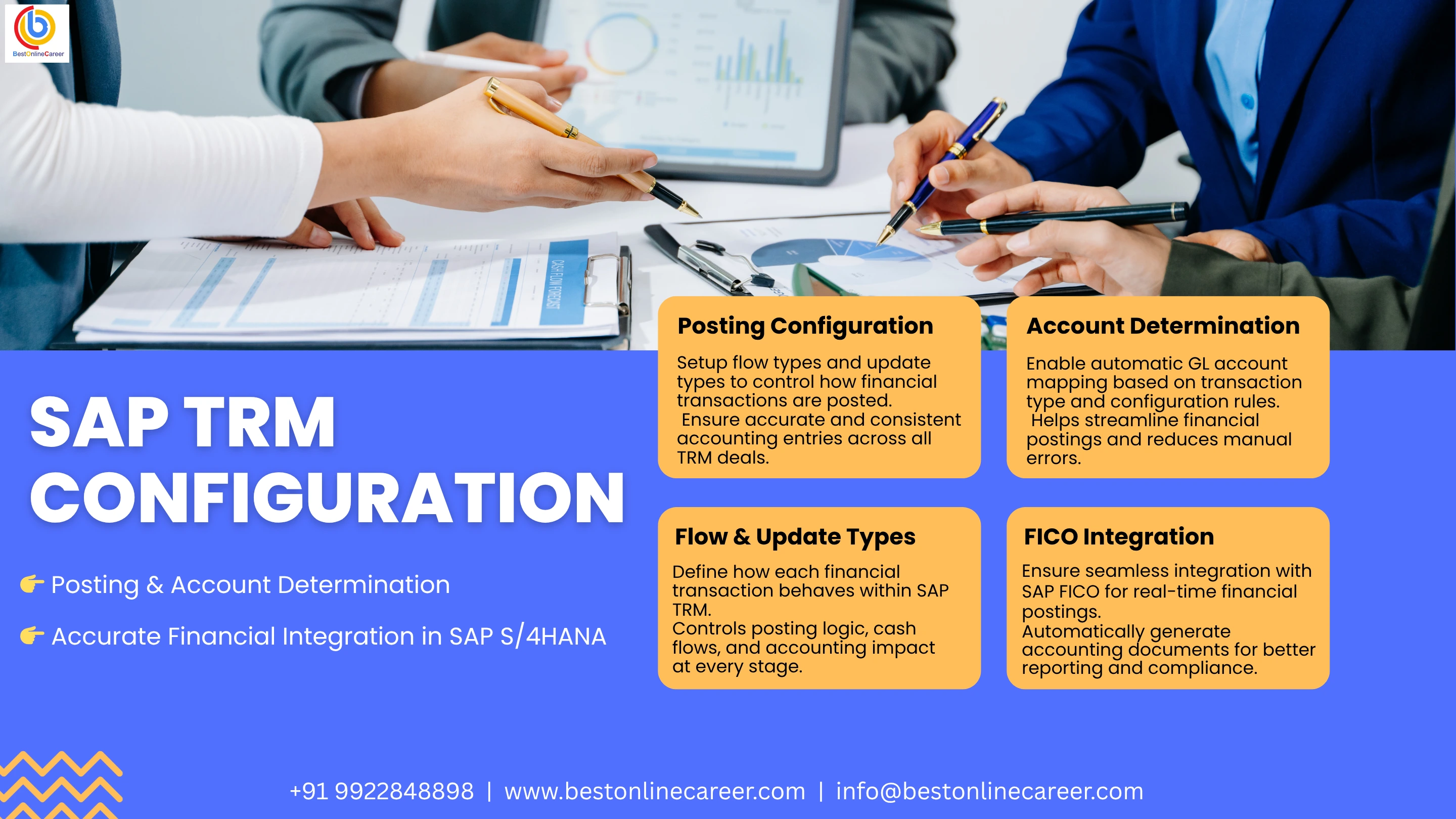
SAP TRM Configuration for Posting and Account Determination
SAP Treasury and Risk Management (TRM) is a module within SAP FSCM (Financial Supply Chain Management) that helps organizations manage financial instruments, liquidity, market risk, and treasury processes in a structured way. At the core of SAP TRM is the configuration for posting and account determination, which connects every treasury activity to the General Ledger (GL) in SAP Financial Accounting (FI).
Whether a treasury professional is working with money market transactions, foreign exchange contracts, interest rate swaps, or bond deals, SAP TRM must automatically translate each business event into accurate accounting records. This happens through a carefully designed configuration that defines which GL accounts receive debits and credits, under what conditions, and in which ledger or company code.
This guide covers every important aspect of that configuration, from foundational concepts to real business scenarios and best practices, serving as a reference for SAP consultants, treasury analysts, finance professionals, and implementation teams working on ECC or S/4HANA-based Treasury projects.
Key Components of SAP TRM Configuration
Before any transaction can be posted in SAP TRM , several core configuration elements must be properly established. These components form an interconnected framework where each element depends on the others, and together they determine how treasury transactions are reflected in the General Ledger.
Product Type
The product type is the most fundamental component in SAP TRM. Every financial instrument is categorized under a product type, such as 55A for fixed-term deposits, 60A for OTC interest rate swaps, or 01A for equities. The product type defines the characteristics of the instrument and drives downstream configuration options, including which flow types, condition types, and update options apply.
Transaction Type
Transaction types sit beneath the product type and categorize the purpose of a deal, for example whether a money market transaction is a loan or an investment. Transaction types determine which fields are available during deal entry and which accounting processes are activated on execution.
Flow Type
A flow type represents a specific accounting movement associated with a treasury deal, such as a principal disbursement, an interest charge, a fee, or a premium payment. Each flow type carries a business meaning assigned to a product category and defines the precise nature of the movement it represents.
Update Types
Update types sit at the core of the posting architecture. They categorize flows from an accounting perspective, distinguishing between principal payments, realized gains, unrealized losses, accrued interest, and amortization amounts. Each update type is linked to specific posting requirements that establish which debit and credit accounts are used.
Account Symbols
Account symbols act as placeholders between accounting logic and the General Ledger. Rather than hard-coding GL accounts directly into update types, SAP TRM uses account symbols that are then mapped to specific GL accounts by chart of accounts and company code. This allows one configuration structure to support multiple company codes with different account numbering schemes.
Posting Specifications
Posting specifications connect everything by defining, for each update type, which account symbol receives the debit entry and which receives the credit entry. They also identify the posting type, determining whether the transaction creates a real financial posting or a statistical one used only for reporting.
Valuation Areas and Accounting Principles
Valuation areas and accounting principles complete the framework by enabling parallel accounting. Organizations that report under both IFRS and local GAAP can maintain separate valuation results and accounting determinations within the SAP system, ensuring compliance with multiple reporting standards simultaneously.
SAP TRM Posting Configuration: Step-by-Step
Configuring SAP TRM for correct posting requires a specific sequence of actions. Skipping or improperly completing any step typically results in posting errors, missing GL entries, or incorrect account assignments that are difficult to trace after go-live.
- Identify and assign flow types to the relevant product categories. This is done in SPRO under Financial Supply Chain Management > Treasury and Risk Management > Transaction Manager > General Settings > Create Flow Types.
- Define update types and connect them to the relevant flow types. Standard SAP provides a broad set of update types, but custom Z-prefix update types can be created for specialized instruments or non-standard business needs.
- Design account symbols using short keys, typically three to four characters, that represent a particular GL account category, such as BNK for bank accounts, INT for interest income, or PRN for principal liability.
- Map account symbols to GL accounts by company code. This mapping is stored in the account determination tables (V_TRTM_ACCDET) and maintained through transaction TPM10 or SPRO customization. Close collaboration between treasury and finance teams is essential at this stage.
- Create posting specifications for each update type, specifying the debit account symbol, credit account symbol, and posting type indicator. This is where the accounting equation for each treasury event is formally defined.
- Configure valuation areas when mark-to-market and accrual postings are required. Valuation areas define the scope for periodic valuation, link to accounting principles for parallel ledgers, and control the period-opening reversal process.
- Verify the full configuration using Transaction Manager's simulation mode before activating in production. Each in-scope product type should be tested with representative deals, and the posting log should be reviewed to confirm that correct GL accounts are hit for each update type and flow type combination.
Account Determination Process in SAP TRM
The account determination process in SAP TRM follows an established resolution hierarchy that the system evaluates at the time of posting. Understanding this hierarchy is essential for diagnosing why a posting was directed to a particular GL account, or why it failed entirely.
When a treasury transaction triggers an update, the system first identifies the update type associated with the flow. It then reads the posting specification for that update type to find the debit and credit account symbols. Next, it searches the account determination table using the combination of chart of accounts, company code, and account symbol to identify the GL account mapping. If a currency-specific mapping exists, it takes precedence over the general mapping. If a valuation area is involved, the system also checks whether an additional account assignment exists for that area.
This hierarchical lookup makes account determination in SAP TRM highly adaptable. The same update type can result in different GL accounts being posted depending on the company code executing the transaction, the currency of the deal, and the accounting principle in effect. This flexibility is one reason SAP TRM suits large multinational organizations with complex accounting requirements.
A common point of confusion is the distinction between account symbols and GL accounts. Account symbols exist only in the TRM customizing layer and do not appear directly in FI. The GL account is what appears in the posted FI document. If an account symbol is not mapped to a GL account for a specific company code, the posting will fail with an error indicating the exact account symbol and company code that requires a configuration entry.
Integration with SAP FICO
SAP TRM is closely integrated with SAP Financial Accounting (FI) and Controlling (CO) , together referred to as SAP FICO. This integration provides TRM with its accounting capability and ensures that every treasury transaction produces accurate, balanced FI documents that are available for audit, financial reporting, and reconciliation.
TRM postings create standard journal entries in the General Ledger. An FI document generated by a TRM posting behaves like any other FI document, including a document type, posting date, line items with debit and credit values, and a reference to the originating TRM transaction. FI accountants can review, reverse, and report on TRM postings using standard tools such as transaction FB03 or the General Ledger reporting suite.
Integration also extends to Business Partner master data. In SAP TRM, each counterparty is represented as a Business Partner with a linked vendor or customer account in FI. When TRM processes a payment or receipt, the FI document updates the open items on the business partner's reconciliation account, enabling automatic matching through SAP Bank Communication Management or electronic bank statement processing.
For CO, TRM postings can be assigned to profit centers, cost centers, or internal orders. This is particularly relevant for organizations that need to allocate treasury income and expenses, such as interest income, hedging costs, and bank charges, to specific business units. Profit center assignment in TRM is typically governed by company code and product type, though transaction-level configuration is also possible for more granular allocation.
Real-World Business Scenario
Ready to Start Your Learning Journey?
Join thousands of learners and build your future with expert-led courses and 100% practical training.
Expert Guidance
Learn from industry experts
Trusted & Recognized
Top-rated by learners
Flexible Learning
Online options
Placement Support
Career support & more
Consider a large manufacturing company with treasury operations in Germany, Singapore, and the United States, using SAP TRM to manage short-term liquidity through a portfolio of fixed-term deposits with partner banks.
At the start of the month, the treasury team enters a 90-day fixed-term deposit of EUR 5 million with Deutsche Bank at 3.5 percent per annum. The deal is recorded in SAP TRM under product type 55A (Fixed-Term Deposit) and transaction type 100 (Investment). At the point of entry, no posting occurs; the deal is simply recorded in TRM.
At period end, the treasury team runs the regular posting program (transaction TPM18). The system evaluates all active treasury transactions and generates postings for flows falling within the posting period. For the fixed-term deposit, it identifies the nominal amount flow and the accrued interest for the period.
For the nominal amount, the update type maps to a posting specification that debits the Fixed-Term Deposit Asset GL account and credits the Bank Clearing GL account. For accrued interest, a separate update type maps to a posting specification that debits the Accrued Interest Receivable GL account and credits the Interest Income GL account.
Both postings are created as balanced FI documents in the German company code's General Ledger. Treasury operations in Singapore and the United States see equivalent postings in their respective company codes, with appropriate local GL accounts determined automatically through currency and account symbol mappings specific to each entity.
When the deposit matures on day 90, the final interest payment triggers a further set of postings that reverse the original asset entry and recognize the earned interest. The entire accounting lifecycle, from initial placement through period-end accruals to maturity, is automated through TRM's posting framework, eliminating the need for manual journal entries.
Common Issues and Troubleshooting
Even well-configured SAP TRM systems encounter posting issues, particularly following organizational changes, chart of accounts reorganizations, or the introduction of new financial instruments. Recognizing common issues and resolving them efficiently is a core skill for any SAP TRM consultant or system administrator.
No Account Determination Found
This is the most frequently encountered error during TRM posting runs. The system searches the account determination table for a specific combination of chart of accounts, company code, and account symbol and finds no entry. The error message identifies the exact missing combination, making resolution straightforward: add the required GL account mapping to the account determination table using transaction TPM10.
Incorrect GL Account Assignment
This issue is more subtle: postings are created, but to the wrong GL account. It typically occurs when account symbols were correctly mapped at initial configuration but were not updated after a chart of accounts change or when a new company code was added to TRM scope. Regular reconciliation between the TRM account determination table and current GL master data helps prevent this.
Missing Flow Types
This is a common issue when new product types are introduced or existing ones are extended with additional transaction types. If a flow type is not assigned to the correct category, it will not generate the appropriate update type and will not produce the expected posting. Simulating postings in Transaction Manager is the most effective way to identify missing flow type mappings before they reach production.
Valuation Run Issues
When the key date valuation run (TPM1) does not produce postings or generates unexpected entries, the cause is typically misconfigured valuation areas, missing valuation class assignments, or absent market data such as yield curves or exchange rates. The valuation log accessible in TPM1 provides precise error messages for each position that could not be valued.
Parallel Accounting Conflicts
Companies maintaining both IFRS and local GAAP ledgers in SAP may encounter situations where the ledger group assigned to a treasury deal does not align with the ledger group expected by the posting specifications. This results in postings failing or being directed to the wrong ledger. Ensuring alignment between TRM accounting principle configuration and FI New GL ledger group setup is essential to prevent this category of error.
Best Practices for SAP TRM Configuration
Successful SAP TRM implementations consistently share a set of configuration practices that reduce errors, simplify ongoing maintenance, and allow the system to scale as business requirements evolve.
- Build the account symbol framework first. Account symbols are referenced across many update types and posting specifications. Changing them after the broader configuration is in place is costly and error-prone. Establish a logical, consistent naming convention and document it clearly for future maintainers.
- Use standard SAP update types wherever possible. Reserve Z-prefix custom update types for genuine business needs that cannot be met by standard content. Custom update types increase maintenance overhead and may conflict with new standard content delivered by SAP upgrades.
- Establish a thorough testing process before go-live. Testing should cover all product types, transaction types, and currency combinations, including not just normal deal execution but also early terminations, reversals, and period-end valuation runs. Use simulation mode extensively to identify account determination gaps before they become production issues.
- Define a change management process for the account determination table. Changes to GL account mappings in a live TRM system can affect the accounting treatment of both open positions and new deals. Each change should be assessed for impact on open positions, tested in a quality system, and moved to production with a documented change request.
- Schedule regular reconciliations between TRM subledger balances and FI General Ledger balances. SAP provides standard reconciliation reports accessible through transaction TPM60 and related reports. Monthly reconciliations, or more frequent ones for high-volume operations, ensure that posting gaps or technical errors are identified and corrected before affecting financial statements.
Configuration Approach for Posting and Account Determination
The configuration of SAP TRM posting and account determination should be treated as a dedicated project workstream rather than a task addressed in the final weeks before go-live. Organizations that have implemented SAP TRM successfully consistently attribute that success to early, structured collaboration between the treasury department, the finance department, and the SAP TRM configuration team during the design phase.
The most effective approach begins with a thorough business process analysis. Before any system configuration is performed, the team should document every financial instrument in scope, every accounting event associated with those instruments, from initial recognition and period-end accrual to fair value measurement and derecognition, and every GL account affected by those events.
This process produces the Account Determination Matrix: a structured document identifying every combination of product type, flow type, update type, posting specification, account symbol, and GL account across all company codes and currencies in scope. This matrix serves as the single source of truth for all configuration work.
With the Account Determination Matrix in place, configuration proceeds in the logical sequence described earlier, with each step tested using representative deal scenarios to confirm that the expected FI documents are produced before moving to the next step. A phased implementation approach, beginning with simpler instruments such as fixed-term deposits and spot FX before progressing to derivatives and structured products, reduces implementation risk and allows the team to build confidence in the configuration framework before addressing the most complex accounting scenarios.
The Business Purpose Behind SAP TRM Configuration
The business process driving SAP TRM configuration reflects the fundamental purpose of any treasury management system: to ensure that the true financial position of treasury activity is accurate, complete, and reflected promptly in the organization's financial reporting.
Every configuration decision in SAP TRM , each account symbol, update type, and posting specification, exists to serve this objective. When a treasurer executes a deal, hedges a currency exposure, or issues commercial paper, the TRM configuration ensures that the accounting team does not need to manually calculate and create journal entries. The system applies the configured rules automatically, for every transaction, every company code, every time.
From a business process perspective, the TRM posting and account determination configuration affects four groups of stakeholders:
- Treasury front office, responsible for deal execution, relies on configuration to ensure transactions are recorded and processed correctly.
- Treasury middle office and risk management, which depends on accurate postings for position reporting, risk assessment, and performance measurement.
- Finance and accounting, which requires accurate GL entries for financial statement preparation, audit support, and regulatory reporting.
- IT and SAP support teams, responsible for maintaining the configuration and keeping it aligned with evolving accounting policies and system changes.
When these four groups collaborate effectively during the design and configuration phases, sharing requirements, validating the Account Determination Matrix, and testing scenarios together, the result is a posting framework that is reliable, transparent, maintainable, and built to last. That collaborative foundation, as much as any individual configuration choice, is what distinguishes successful SAP TRM implementations from those that struggle with reconciliation issues, manual corrections, and post-go-live instability.
Related SAP Training Courses
Tags
Share this article
Help others discover this valuable SAP content