
Advanced SAP MDG Technical Concepts & Training Guide
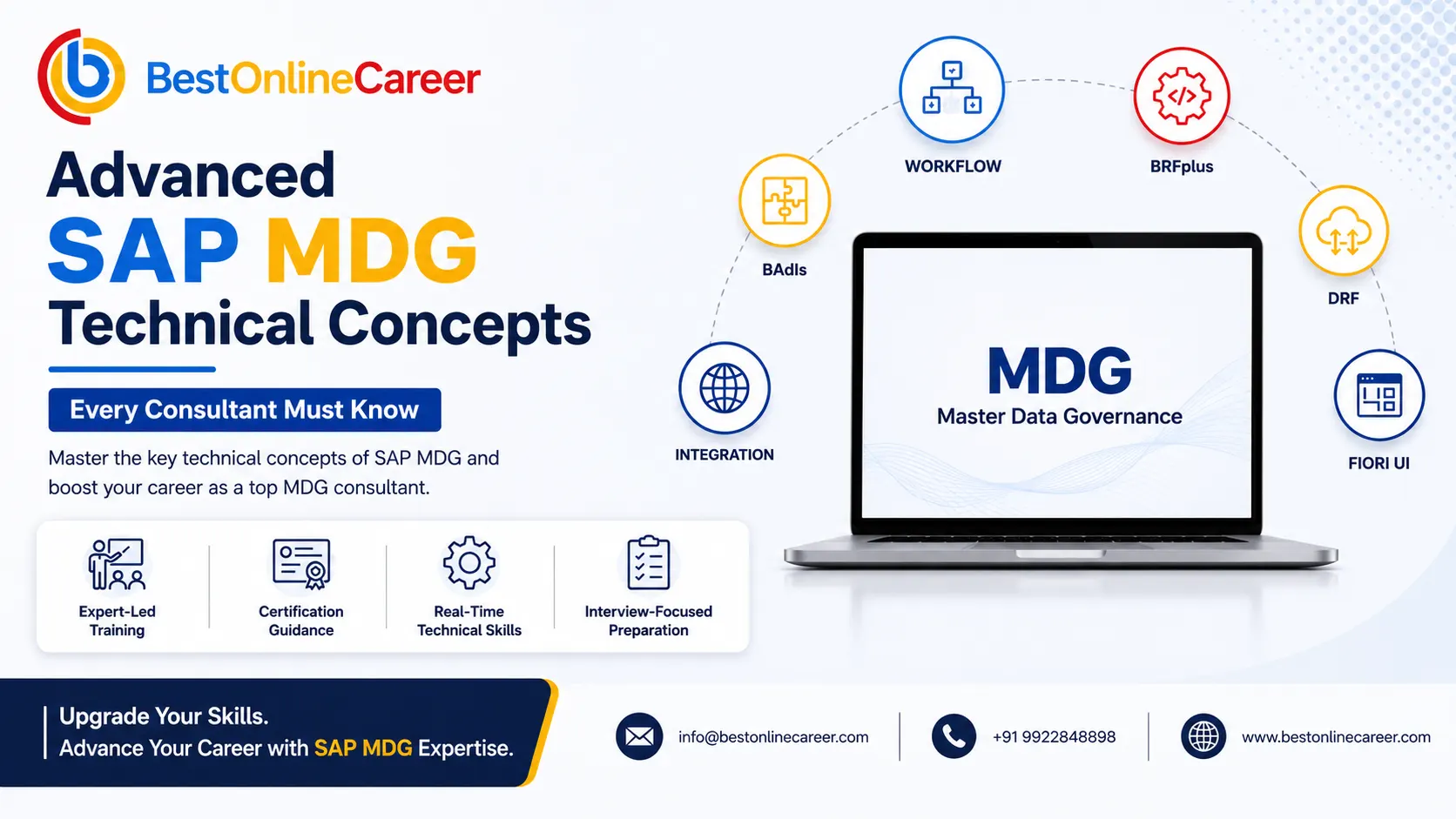
Advanced SAP MDG Technical Concepts Every Consultant Must Know
In the modern, data-driven world of enterprise with a consistent and clean master data is no longer an option but is a must for competitive success. SAP Master Data Governance (MDG) is the foundation of data quality in enterprise that allows companies to develop, alter master data and share it over SAP or non-SAP platforms in a manner that is precise and control.
When you're planning to answer the SAP MDG interview for technical questions and/or registering for the SAP MDG's technical classes or seeking the SAP MDG Certificate, this guide will give you the in-depth technical understanding that differentiates ordinary consultants from top professionals. From governance-related frameworks and customized UI setup, this guide will cover every concept that you'll need to establish a lucrative profession as an SAP MDG technical consultant.
What Is SAP MDG and Why Does It Matter?
SAP Master Data Governance is an SAP solution based upon the SAP NetWeaver platform. It offers centralized governance, workflow-driven verification and a seamless sharing of master information like business partners, materials, customers, suppliers and financials.
The primary value idea for SAP MDG lies in three principals:
- Central Governance — A single central hub for master data updates and creation with integrated approval workflows.
- Mass Processing — Bulk processing of master data records using internal validation tools.
- Consolidation as well as Central Remediation — Matching, merging and removing data from multiple sources.
For anyone who wants to become an SAP MDG consultant, knowing these pillars at an architectonic level — not just at the functional level — will be the initial step to mastery.
Core Architecture: The Technical Foundation
1. The MDG Hub Concept
SAP MDG operates on a hub-and-spoke design. Its central MDG hub is the center of the entire workflow process, governance logic and management of change requests. Spoke applications (typically ERP or S/4HANA instances) receive master data governed through distribution mechanisms.
Important architectural components that each SAP MDG tech professional needs to know:
- Business Activity (BA) — The point of entry to start the process of requesting changes.
- Change Request (CR) — The governance object that keeps track of every change including the status of workflows, validity dates and approval history.
- Staging Area — The intermediate storage area in which proposed master data updates are stored prior to release and activation.
- Active Area — The production-equivalent area where approved data lives post-activation.
2. Data Model Framework
The SAP MDG data model is built on the idea of entity types and relationships. They are set up in MDG's customization environment and determine the structure of objects that are governed.
Understanding the model of layered data is crucial to the SAP MDG Training for technical experts:
- Reuse Model — Utilizes already existing SAP information structures (like BP or Material) with MDG governance layers over.
- Flex Model — It allows for the creation of completely custom data models tailored to the needs of business objects.
Consultants who develop and expand models of both types are sought-after on the market.
Advanced Technical Concepts for SAP MDG Consultants
3. BRFplus Integration for Validation Rules
Business Rules Framework plus (BRFplus) is the core engine that runs SAP MDG's validation logic. Every change request goes through BRFplus-configured rules, which establish standards for data quality prior to data entering the active zone.
The most important BRFplus components in the MDG context:
- Rule Services — Modular validation logic tied to particular field groups or entity types.
- Decision Tables — Tabular rule settings that allow business users to handle validation without ABAP programming.
- Expression Types — Formula-based, database lookup, and procedural expressions that can handle complex validation scenarios.
The top SAP MDG certification tests often test a consultant's capability to design BRFplus rules services that cause conditional validations across dependent fields — for instance, making sure that the payment terms of a supplier are always in line to their group of accounts.
4. SAP Workflow Integration (SWF)
Workflow is the foundation of MDG's approval process. SAP MDG leverages the classic SAP Business Workflow (SWF) framework, but modern implementations often use SAP Build Process Automation (formerly SAP Intelligent RPA) to provide advanced orchestration.
The technical areas that every MDG consultant must be proficient in:
- Workflow Templates (WS*) — Standard and custom workflow templates that are associated with the different types of change requests.
- Agent Determination — Rules-based routing of work-related items to appropriate approvers by using organizational structures or custom BAdIs.
- Substitution Rules — Controlling absence of approvers and delegation in governance processes.
- Deadline Monitoring — Configuring escalation pathways in the event that SLAs are not met within approvals.
When answering the SAP MDG technical interview questions, you should expect scenario-based questions where you'll need to develop multi-step approval workflows that can be used to manage complicated organizational hierarchy.
5. BAdIs (Business Add-Ins): The Extension Framework
SAP MDG is heavily BAdI-driven, which means that nearly every technical feature can be improved or changed via the standard enhancement points. This is among the most tested areas of training for SAP MDG certified courses.
The most important BAdIs to understand:
| BAdI Name | Purpose |
|---|---|
| USMD_SSW_WORKFLOW | Custom workflow routing logic for workflows |
| USMD_RULE_SERVICE | Custom rule service execution |
| USMD_GOV_API_EXIT | Pre/post processing during governance API calls |
| MDG_BS_BP_UI_HOOK | Custom UI behavior in Business Partner scenarios |
| USMD_ENTITY_VALUE_AV | The values available for entity attributes in the UI |
A consultant who is able to implement these BAdIs in a clean way with clear ABAP code and solid documentation will always outperform their competitors in both interviews and on-the-job deliveries.
6. SOA/Web Services for MDG Integration
The most sophisticated and often neglected SAP MDG technical capabilities involves mastering the Service-Oriented Architecture (SOA) integration layer.
Ready to Start Your Learning Journey?
Join thousands of learners and build your future with expert-led courses and 100% practical training.
Expert Guidance
Learn from industry experts
Trusted & Recognized
Top-rated by learners
Flexible Learning
Online options
Placement Support
Career support & more
SAP MDG exposes governance processes through Enterprise Services that external systems may consume. This includes:
- MasterDataGovernanceMaterialIn — Inbound service for material governance.
- BusinessPartnerSUITEBulkReplicateRequest — For mass BP replication.
- Custom Web Services — Built using the MDG Governance API (USMD_GOVERNANCE_API) and wrapped in a standard SAP service provider class.
Consultants working within the SAP MDG technical education environments, practicing the end-to-end service invocation with SOAP UI and mapping the response processing in MDG error logs can be an excellent practice.
7. SAP MDG Data Replication Framework (DRF)
The Data Replication Framework (DRF) is how approved master data is transferred from the MDG hub to spoke systems. This is an essential component that directly affects accuracy of data across a corporate landscape.
Important DRF concepts:
- Outbound Implementation — Defines which objects are replicated and to which systems.
- Replication Models — Configuration objects that link businesses to outbound applications.
- Filter Objects — Business rules that decide the possibility of having a record replicated to a particular system.
- Change Pointers — The technical mechanism to determine the changes in records and require replication.
One of the most frequent issues among junior consultants is that they do not understand the way DRF manages failure situations. Senior consultants must be able to keep track of the replication queues (via DRFOUT), manage failed IDocs, and configure retry logic.
8. SAP Fiori-Based MDG UI Configuration
The latest SAP MDG deployments are based on SAP Fiori, which replaces the old Web Dynpro-based GUI. The ability to comprehend Fiori-based MDG user interface is now a requirement for every SAP MDG technical consultant working in S/4HANA environments.
Important technical areas:
- Floor Plan Manager (FPM) — The base Fiori framework that is used to create MDG UI components such as overview, search as well as editable pages.
- UIBB (UI Building Blocks) — Granular UI components (form, list, toolbar) that are able to be put together and configured with no code.
- OVP (Overview Page) — The entry point based on role for MDG navigation in the work center.
- Feeder Classes based on ABAP — Individual ABAP classes that provide information to UI building blocks, which allows complete control of the programmatic aspects that users can see and interact with.
SAP MDG certification tests are increasingly focusing on Fiori-based scenarios. Therefore, practicing hands-on in the Fiori-enabled MDG system is crucial.
Key Areas Covered in SAP MDG Technical Interview Questions
If you're currently in the process of looking to interview in the field of SAP MDG roles, here are the technical areas that interviewers are always looking for:
- Data Model Design — Do you have the ability to design a Flex Model for your customized governance object from scratch?
- BRFplus Rule Design — Walk through the steps to configure a cross-field validation with decision tables.
- Workflow Configuration — What do you do in an event where multiple approvers are required depending on the spending thresholds and countries?
- Troubleshooting with DRF — The replication task fails silently. Walk through the debugging process.
- BAdI Implementation — Which BAdI would you choose to use to implement custom field defaulting logic for a business partner change request?
- API-Based Integration — Explain the process by which an external site would submit a request for creation of a material to MDG through Web Services.
- Consolidation Configuration — What steps are required to set up a match and merge scenario for consolidation of business partners?
The ability to write structured, scenario-based responses for these types of questions — supported by real-world experience or sandbox training — is what differentiates applicants who get offers.
SAP MDG Technical Training: What to Look For
When choosing the SAP MDG technical training, prioritize the courses that include:
- Hands-on access to the system in a SAP S/4HANA MDG sandbox.
- The coverage for both SAP ECC MDG as well as S/4HANA MDG to enhance career flexibility.
- Real-world scenarios of projects including data model design, workflow, BRFplus, DRF along with Fiori UI.
- ABAP improvement exercises that cover BAdI implementation and the use of Governance API.
- Practice exercises that are specifically aligned with the SAP MDG certification exam questions.
Online platforms that offer structured, project-based SAP MDG technology education will yield the highest ROI for consultants who want to transition to or advance in this field of expertise.
SAP MDG Certification Training: What You Need to Know
The main SAP certification that is relevant to this area is:
SAP Certified Application Associate — SAP Master Data Governance
Exam domains that are covered within the SAP MDG certification training courses:
| Domain | Approximate Weight |
|---|---|
| Central Governance Configuration | 25% |
| Data Modeling and Data Quality | 20% |
| Workflow and Process Design | 20% |
| Consolidation and Mass Processing | 15% |
| Integration and Distribution | 12% |
| Fiori UI and SAP Build | 8% |
Highly recommended method of preparation:
- Complete the official SAP Learning Hub courses on MDG.
- Additional training by utilizing third-party SAP certification courses which includes mock exams.
- Learn to answer practice SAP MDG certification questions using multiple resources, with a focus on scenario-based and multi-select questions.
- Create a cheat sheet for yourself to keep track of BAdI names, DRF transaction codes as well as BRFplus-specific expression types.
Career Outlook for SAP MDG Technical Consultants
The need for highly experienced SAP MDG technical consulting experts continues to increase as organizations accelerate S/4HANA transformations. The master data governance process is often one of the first work streams included in any transformation project, making MDG consultants vital from the beginning.
The salary benchmarks of SAP MDG technical consultants vary depending on the region and level of experience, however, mid-level to senior level consultants always receive competitive compensation both in permanent and contract markets. The combination of functional knowledge and profound SAP MDG technical capabilities — specifically the development of BAdI, design for BRFplus and DRF configuration — creates a profile that is unique and commands premium rates.
Conclusion
Learning to master SAP MDG at a technical level requires more than simply reading documentation. It demands actual experience in configuration, a solid ABAP base, as well as an ability to convert requirements for business governance into technical solutions. Beginning with validation for BRFplus to SWF workflow design, to Fiori UI and DRF replication elements, each concept that is covered in this guide represents real expertise that enterprise customers pay for.
If your next goal is passing the SAP MDG technical interview, or the completion of SAP MDG technical training, or obtaining an SAP MDG certificate, investing in these high-tech capabilities will help you stand out within one of SAP's top-demanding areas of expertise.
Begin with a planned SAP MDG certification training program, practice in the live system, and create the portfolio of knowledge that will make you the expert that every project team wants.
Related SAP Training Courses
Tags
Share this article
Help others discover this valuable SAP content


