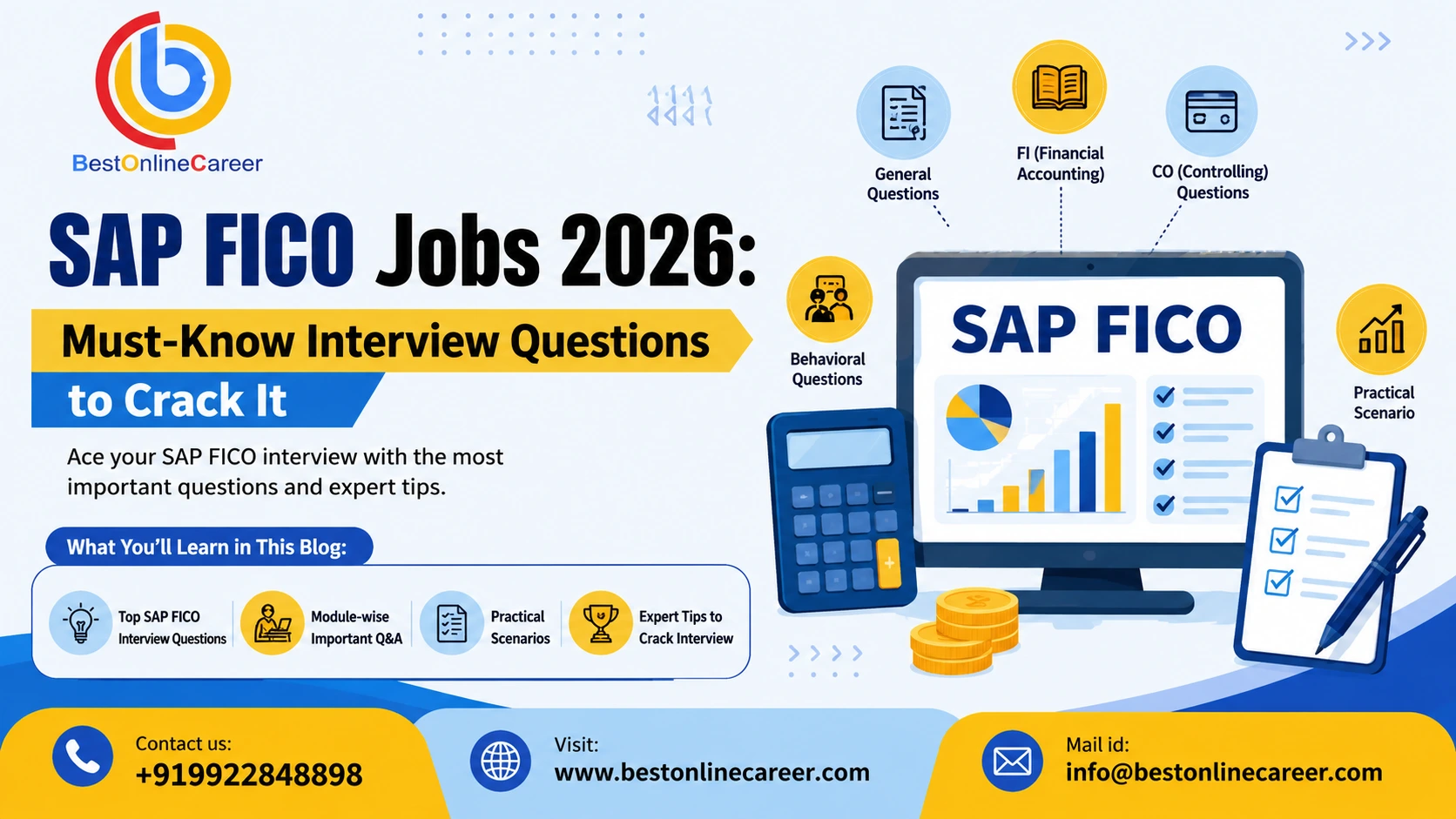
SAP FICO Jobs 2026: Must-Know Interview Questions to Crack It
Introduction to SAP FICO Career Opportunities in 2026
Start by describing the meaning of SAP FICO in just one or two sentences, as some people searching for sap fico consultant jobs might not be familiar with the concept (Financial Accounting and Controlling module from SAP).
Give a reason as to why SAP FICO continues to be useful even as newer technologies are developed, since every business, regardless of industry, requires strong budgeting and control systems for financials.
Name specific industries that will be employing SAP FICO consultants in 2026, for example manufacturing, pharmaceuticals, retail, banking, and IT services, to provide readers with a better understanding of the areas where there are opportunities.
Indicate the effects of the ongoing S/4HANA adoption. A lot of businesses are still migrating from ECC to S/4HANA, and this change alone has led to a surge of openings for new consultants.
It is also possible to mention how the growth in cloud ERP and automation, along with AI-driven tools for finance, are changing the expectations of SAP FICO experts, which makes this an excellent introduction to the next section.
Career Growth and Salary Trends for SAP FICO Professionals
Define the typical career route such as Junior SAP FICO Consultant, Senior Consultant, Team Leader, SAP Solution Architect, or Project Manager, so that readers can understand the long-term direction.
Define how salary varies depending on three major factors: experience level, certification status (SAP certified vs non-certified), and location (metro cities and large corporations generally offer higher salaries).
It is important to note that those with S/4HANA Finance experience are currently receiving a higher salary than those with only ECC expertise, as companies are focusing on hiring people who can support their migration plans.
The rise of freelance and remote consulting jobs allows skilled consultants to collaborate with international clients and usually earn money in foreign currency, thereby increasing the potential for income.
You can also make a point that certificates alone don't suffice; practical, hands-on project experience is what determines salary negotiation in an interview.
Key Skills Required for SAP FICO Consultant Jobs
Technical Skills
Discuss the technical skills that include the ability to navigate and configure SAP using SPRO (the settings menu), as well as creating charts of accounts and defining company codes.
Include integration expertise and understanding of how FICO integrates with MM (Materials Management) for postings related to procurement, as well as SD (Sales and Distribution) for revenue postings.
Make sure to highlight that basic ABAP debugging abilities, though not required, are becoming appreciated because they allow consultants to solve problems without relying on a developer.
Mention tools such as LSMW and LTMC. These are tools used to upload master data and are often tested in technical interview rounds.
Functional Skills
Explain how functional skills are built on real understanding of finance and accounting, knowing general ledger accounting, accounts receivable, payables, and asset accounting procedures.
Develop a solid understanding of controlling, such as cost center accounting (tracking departmental expenses), profit center accounting (tracking the performance of business units), and internal orders (tracking specific events or projects).
Be sure to emphasize the importance of being competent to translate a customer's business requirements, for example "we need automated vendor payments," into the right SAP steps to configure.
It is important to note that functional consultants also require good communication skills since they frequently serve as an intermediary between the finance department and the technical SAP team.
SAP FICO Job Titles You Should Know
SAP FI Consultant
The job description should be focused around the "Financial Accounting" side, managing configurations that relate to the general ledger, accounts payable, accounts receivable, bank accounting, and asset accounting.
Explain the concept that FI consultants typically work with the accounts and finance department of a customer to ensure compliance with the law as well as accurate reporting, and smooth closing at month end and year end.
It is important to mention that FI consultants can specialize in areas like Treasury and Asset Accounting, based on the requirements of the project.
SAP CO Consultant
This role should be described as being focused on internal management reporting, rather than external financial reporting, helping companies figure out where funds are being used internally.
Define the key responsibilities: cost center accounting and profit center accounting, product costing (used in manufacturing), and profitability analysis (COPA).
Indicate that CO consultants frequently collaborate with operations and production teams to develop accurate costing models, particularly in industries with a high volume of manufacturing.
Basic SAP FICO Interview Questions
General Concepts
Ready to Start Your Learning Journey?
Join thousands of learners and build your future with expert-led courses and 100% practical training.
Expert Guidance
Learn from industry experts
Trusted & Recognized
Top-rated by learners
Flexible Learning
Online options
Placement Support
Career support & more
Explain that interviewers use these sap fico interview questions to see if the candidate has a solid fundamental understanding, not only memorized definitions.
Common questions could focus on the differences between FI and CO, the reasons why they are used together, and what business problems SAP FICO solves.
Mention that candidates must be competent in explaining, using easy language, the organization structure: company code, business area, and controlling area, as this topic is frequently brought up during interviews.
Configuration Basics
This section is a test of actual understanding of SAP and not just theory, such as the process of defining the company code or establishing the fiscal year variant.
Candidates are often required to walk through a simple process they've experienced personally, so exposure to a real project is important here.
Discuss posting periods and the way they determine open and closed periods for transactions, because this is a widely tested fundamental idea.
| Question | Answer |
|---|---|
| What exactly is SAP FICO and why is it so important for businesses? | SAP FICO is short for Financial Accounting (FI) and Controlling (CO), the two main components of SAP ERP. FI manages external financial reporting and CO handles internal cost monitoring and analysis. Together, they help businesses stay compliant while making informed business decisions. |
| What's the difference between FI and CO? | FI concentrates on external reporting, such as balance sheets, P&L statements, and legal compliance. CO is focused on internal reporting, such as budgeting, cost tracking, and profitability analysis for use by management. In short, FI is designed for outsiders, CO is designed for internal decision-making. |
| Why are FI and CO used together, instead of being used separately? | FI and CO are linked because financial transactions usually require both external and internal cost tracking. For instance, a vendor invoice posted in FI can be associated with a cost center in CO. This helps ensure transparency and compliance simultaneously. |
| Can you explain company code, business area, and controlling area? | The company code is the smallest legal entity for which complete financial statements are made. Business area is an additional option for reporting on a product or region. Controlling area sits above company codes and handles internal cost tracking for several of them. |
| What's involved in defining a company code, and why is it so important? | Defining a company code involves assigning a unique code, filling in company details, and connecting it to a chart of accounts and fiscal year variant. This is a crucial step as nearly all FI configurations depend on it. Errors here can impact the entire structure of financial reporting. |
| What are posting periods and why are they important? | Posting periods define the accounting period that is either closed or open for entry of transactions, in accordance with the fiscal year variant. They help ensure financial discipline by locking closed periods to avoid unwanted adjustments. This is crucially important at month-end and year-end closing. |
Intermediate SAP FICO Interview Questions
Financial Accounting (FI) Questions
Discuss how this level goes beyond definitions and tests applied knowledge, such as how the Automatic Payment Program (APP) is set up and used to make bulk payments to vendors.
Mention the dunning procedure, the method of sending reminders about payment dates to customers, and how it's implemented according to business rules.
Controlling (CO) Questions
Define cost allocation strategies such as assessment cycles, which assign costs based on percentages or statistical keys, and distribution cycles, which allocate costs based on the original cost element.
Include internal order settlement, how costs incurred within an internal order are eventually settled to a cost center or asset.
| Question | Answer |
|---|---|
| What is the Automatic Payment Program (APP), and why do you use it? | APP is a tool within SAP FI used to handle vendor payments in bulk, in accordance with due dates and payment terms. It helps reduce manual work and ensures prompt, accurate payments. Configuration involves creating payment methods, house banks, and payment runs. |
| How does the Automatic Payment Program actually work in a real-life scenario? | APP selects open vendor invoices by analyzing parameters such as company code, payment method, and due date. It then generates a proposal, which is reviewed and modified prior to final payment execution. Once approved, it creates payment documents and updates vendor accounts. |
| What is the dunning process within SAP Financials? | Dunning is the process that sends automated notifications to clients regarding past due payments. It's set up with several dunning levels, each having distinct reminder text and urgency. Businesses use it to maintain cash flow and reduce outstanding receivables. |
| What's the difference between assessment and distribution cycles in CO? | Assessment cycles assign costs to receivers based on percentages or statistical keys, and the original cost element is replaced by a secondary cost element. Distribution cycles also assign costs but retain the original cost element. Both are used for cost allocation, but differ in how costs are tracked. |
| What is internal order settlement, and what is the reason for it? | Internal orders are used to collect costs for a specific project, event, or task. Settlement involves transferring these costs to a final cost object such as a cost center or asset. It ensures that costs are reported in the correct place. |
| Can you describe a real-time scenario involving cost allocation based on assessment or distribution cycles? | For instance, IT department costs can be distributed to other departments according to usage percentages through an assessment cycle. This helps distribute shared costs evenly across cost centers. It's often used for expenses like admin, HR, or IT support. |
Advanced SAP FICO Interview Questions
Integration Scenarios
Answer that these sap fico interview questions examine whether the candidate comprehends SAP as a networked system, not just one individual FICO module.
Examples include account determination in MM, how the system determines what GL account to post to when a purchase is made, as well as revenue recognition in SD, how sales postings are transferred to financial accounting.
Real-Time Problem Solving
This section is intended to test the ability to troubleshoot problems in a practical manner, for example how to resolve a posting error during period-end closing.
Discuss common real-world issues, such as reconciliation mismatches between subledgers and the general ledger.
| Question | Answer |
|---|---|
| How does account determination work when integrated with MM to FI? | If a goods receipt or invoice is posted in MM, the system automatically identifies the correct GL account based on the settings of transaction OBYC. This is done based on the combination of valuation class, transaction key, and chart of accounts. It ensures expense and inventory postings are correctly inserted into FI without manual intervention. |
| How does revenue recognition function in SD integration with FI? | When a sales order is billed in SD, the system posts revenue to FI through account determination settings (VKOA) based on the sales organization, account key, and material. This ensures revenue is accurately recorded on financial statements, reflecting the "Order to Cash" process working seamlessly across modules. |
| Could you describe the "Procure to Pay" process and how FICO fits in? | Procure to Pay begins with a purchase order in MM, followed by goods receipt and invoice receipt, which are then posted to FI. FICO ensures accurate GL postings, vendor liability tracking, and payment processing at the end. It demonstrates how MM and FI collaborate during a real business cycle. |
| How do you fix a posting error during period-end closing? | First, identify the exact error message and verify if the posting period is open for that document type. Then, check that the account assignment, cost objects, and master data are correct. If necessary, work with the technical team to look into configuration or authorization issues. |
| What causes reconciliation mismatches between subledgers and the general ledger, and how do you fix them? | This is usually caused by inaccurate postings, missing documents, or misconfiguration in account determination. To resolve it, check subledger balances, such as vendor or customer accounts, against the GL reconciliation account to identify the difference. Fixing the root cause and re-running reconciliation reports usually resolves the issue. |
| How do you deal with a real-time situation where incorrect account determination causes failed postings? | First check the OBYC and VKOA settings to determine which one is missing or incorrect. Then correct the account assignment based on the business context, such as valuation class and transaction key. Finally, reprocess the failed postings once the configuration has been corrected. |
Common Mistakes to Avoid
Explain why many candidates fall into the trap of providing only textbook definitions without linking them to actual field experience, which makes answers appear thin.
It is important to note that many candidates do not explain the "why" behind a configuration choice; interviewers want to know the business reasoning behind it, not just the technical details.
Be aware that being unprepared to answer integration questions is a typical omission, because many candidates concentrate on their own module and don't consider how it relates to MM, SD, or other areas.
Be aware that not mentioning any experience with S/4HANA, even basic exposure, could hurt applicants applying for sap fico consultant jobs in 2026, as most businesses now expect at least a basic understanding of it.
How to Answer Scenario-Based Questions
It is suggested to use a three-part structure: first explain the business challenge, then explain the SAP solution that was used, then describe the results or outcomes obtained.
Instruct candidates to draw from real-world examples whenever possible, as specific, real-world answers are superior to generic answers.
Be sure to remain calm and rational when describing troubleshooting procedures, even for hypothetical scenarios the candidate hasn't personally experienced.
We recommend practicing explanations in simple, concise language, as interviewers value clarity in communication just as much as technical understanding.
Where to Find SAP FICO Consultant Jobs in 2026
Top Job Portals and Platforms
Make sure to mention major platforms such as LinkedIn or Naukri as good places to start your search for sap fico consultant jobs, as most companies and recruiters advertise SAP positions there.
Consider looking into specific SAP job boards and company career pages, as SAP partner companies usually offer a steady flow of project-related openings.
It is recommended to set up job alerts using specific keywords such as "SAP FICO Consultant" or "SAP S/4HANA Finance" to keep track of new jobs as they become available.
Freelance vs Full-Time SAP FICO Roles
Explain that freelance positions allow for flexibility, varied projects, and typically higher hourly fees, making them a good choice for professionals accustomed to working independently.
Explain that full-time jobs provide security, structured career development, benefits, and more predictable income, which might be a good fit for people earlier in their career or who want long-term security.
The best choice depends on individual preferences, such as risk tolerance, desired work-life balance, and career objectives.
Related SAP Training Courses
Share this article
Help others discover this valuable SAP content