
SAP EWM Drives Efficiency from Warehouse to Production: A Complete Guide
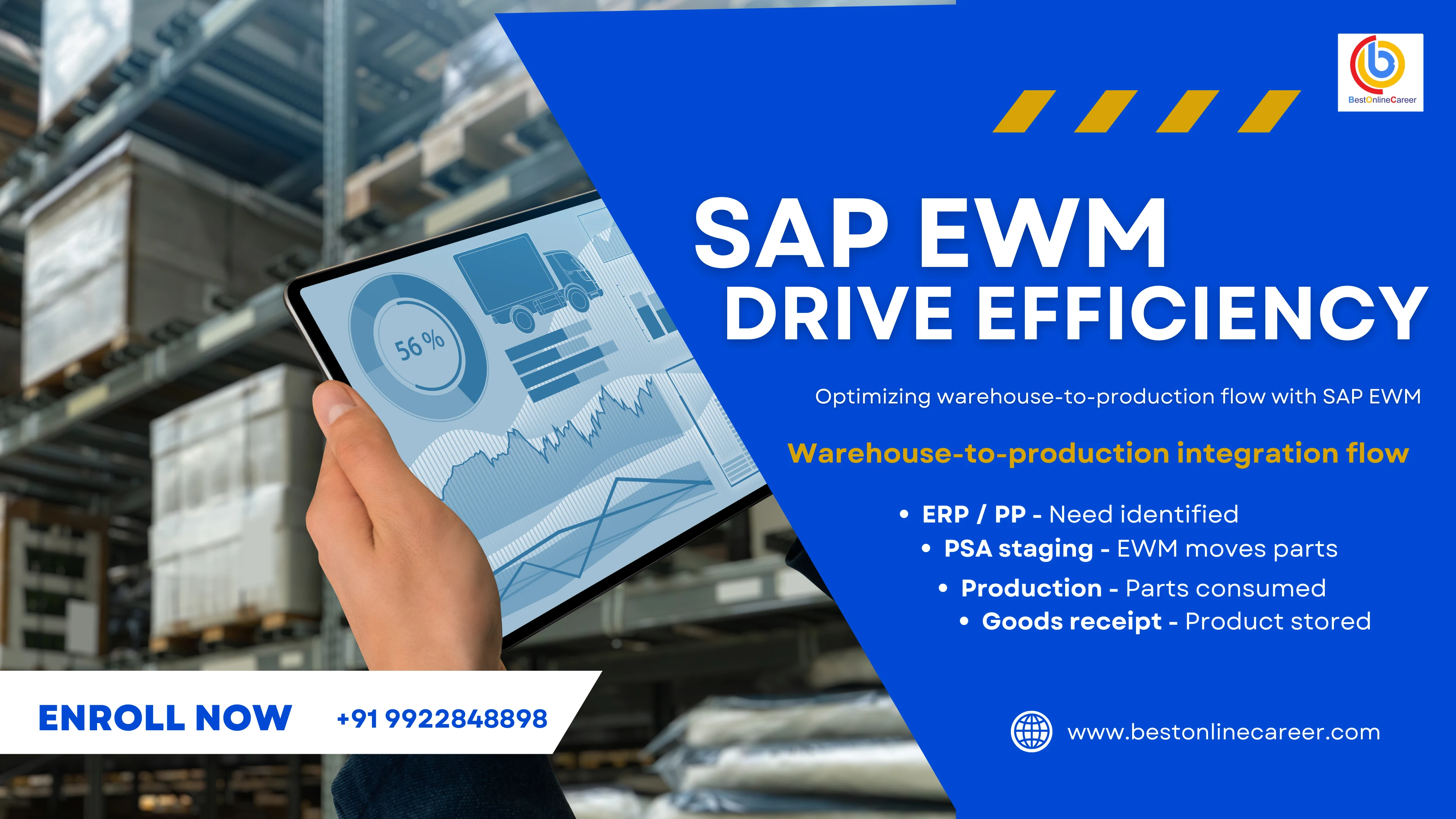
How SAP EWM Drives Efficiency from Warehouse to Production: A Complete Guide
In today's highly competitive manufacturing environment, operating speed and precision are not a luxury — they are the basis of survival. As supply chains around the world grow more complex and customer expectations continue to rise, companies face constant pressure to cut delays, reduce waste, and ensure that the correct materials are delivered to the right location at exactly the right moment. This is precisely why SAP EWM drives efficiency across all levels of production and warehouse operations, acting as a crucial bridge between shop floor management and storage execution.
Understanding What Warehouse Means in the Modern Context
Before diving into the technology, it helps to revisit what the word "warehouse" actually means in today's supply chain. Warehouses are no longer static storage areas where goods simply sit and wait. Modern warehouses are active, fast-moving environments where goods are received, inspected, sorted, staged, picked, packed, and shipped — often within hours. They serve as central hubs connecting production lines, suppliers, and the end customer.
Managing this complexity with spreadsheets or legacy systems is simply no longer viable. Businesses need intelligent platforms that can handle thousands of concurrent warehouse tasks, deliver real-time visibility, and respond quickly to shifts in demand or supply. SAP Extended Warehouse Management was built precisely for this purpose, and SAP EWM training equips professionals to deploy and manage it effectively.
What Is SAP EWM and Why Does It Matter?
SAP Extended Warehouse Management (EWM) is a comprehensive enterprise solution that handles every aspect of warehouse operations. It goes well beyond traditional inventory management and covers a wide range of processes:
- Unloading and goods receipt from inbound trucks and suppliers
- Put-away logic based on bin capacity, storage type, and material-specific characteristics
- Picking and packing for outbound deliveries as well as internal production supply
- Labor and resource management to maximize utilization of forklifts, conveyors, and workers
- Quality management integration that enables inspections at key checkpoints before materials reach final storage
- Real-time tracking through desktop dashboards and mobile PDA devices
What sets SAP EWM apart as a game changer is its seamless interoperability with other SAP modules — including Transportation Management (TM), Yard Logistics, and, most critically for manufacturers, Production Planning (PP). This is where SAP EWM drives efficiency at its most powerful level, ensuring that production lines never run dry and that finished goods return to storage without delay.
The Warehouse–Production Connection: Production Supply Areas
At the heart of EWM-PP integration is the Production Supply Area (PSA) — a designated staging zone positioned close to the production line where components are ready for immediate use. Instead of workers scrambling to retrieve parts mid-production, materials are pre-staged in precise quantities, waiting when they are needed most.
The typical integration flow follows a clear, orderly sequence:
| Step | What Happens | Who Drives It |
|---|---|---|
| Requirement Generation | Production planning determines which components are needed, in what quantities, and at what times | SAP PP / ERP |
| Staging | EWM generates warehouse tasks to move components from general storage bins to the PSA | SAP EWM |
| Consumption Recording | As components are used on the production line, movements are recorded and inventory is updated in real time | Shop Floor / EWM |
| Finished Goods Receipt | Once assembled, the finished product is taken into the warehouse and either put away or prepared for shipment | SAP EWM / ERP |
This closed loop eliminates guesswork, reduces idle time, and ensures that production and warehouse teams always work from the same live picture.
Two Integration Models: Choosing the Right Fit
SAP offers two main models to connect EWM to production planning. Understanding the distinction is essential when planning an implementation or preparing for an SAP EWM program.
1. Delivery-Based Integration
In this model, the ERP system acts as the primary decision-maker. It determines which materials are required and creates delivery documents, which EWM then uses to drive the picking and movement process. This approach works well when:
- The production facility and warehouse are physically separated
- The same logistics team manages both customer order fulfillment and production supply
- A more centralized control structure is preferred
2. Advanced Production Integration
This more sophisticated model gives EWM an active role. Rather than simply following delivery documents generated by ERP, EWM uses a Production Material Request (PMR) to manage staging and consumption directly. This method is ideal when:
- Production and the warehouse are located on the same property
- Component consumption patterns vary from planned quantities
- Dedicated teams manage production and warehouse operations separately
- Accurate, real-time consumption reporting is a business requirement
For businesses running SAP S/4HANA, both integration models are typically available in the standard package, making the advanced model accessible without additional licensing costs.
Four Types of Production Components
Ready to Start Your Learning Journey?
Join thousands of learners and build your future with expert-led courses and 100% practical training.
Expert Guidance
Learn from industry experts
Trusted & Recognized
Top-rated by learners
Flexible Learning
Online options
Placement Support
Career support & more
In the Advanced Production Integration model, materials are grouped into four categories, each with its own replenishment and tracking process. This classification is a cornerstone topic in any professional SAP EWM training course or warehouse management system course.
| Component Type | Description | Example |
|---|---|---|
| Pick Parts | Large, unique items tied directly to a specific production order. Each is individually picked and tracked with precision. | Vehicle frame, custom chassis |
| Cross-Order Parts | Components shared across multiple production orders. EWM consolidates requirements and picks in bulk to minimize trips. | Standard connectors, wheels, fasteners |
| Crate Parts | High-frequency consumables stored in the PSA and replenished automatically when stock falls below a set threshold. | Bolts, bearings, adhesives, lubricants |
| Not Relevant for Staging | Materials that bypass EWM warehouse tasks entirely, consumed directly from fixed supply points. | Bulk fluids via pipelines or silos |
The automation behind crate parts replenishment is particularly valuable — it directly prevents production stoppages without any manual intervention from warehouse staff.
A Real-World Scenario: Wagon Assembly
To put these concepts into context, consider a wagon assembly factory using SAP EWM to supply its production lines.
The process begins with the production order report, where managers review all active orders and their current statuses — created, released, confirmed, or delivered — alongside scheduled dates. When an order is released, it signals that components are ready for warehouse handling.
Inside the warehouse, the newly released order appears as a Production Material Request (PMR) in the Warehouse Management Monitor. The PMR contains every required item, precise quantities, and the exact PSA to which materials must be delivered.
Using the Stage for Production tile, warehouse workers get a consolidated view of requirements across all components. The system automatically determines the best bins to pick from based on physical layout, aisle access, and storage type. Warehouse tasks are generated and confirmed via desktop or mobile PDA, and items are moved to the PSA well before the production team starts its shift.
As assembly progresses, flexible consumption reporting allows workers to record actual usage in real time — even when consumption differs from the planned quantity. Over-consumption and under-consumption are handled gracefully, and the system tracks what was actually used, not just what was scheduled.
Once the wagon is fully assembled, a worker scans the production order using a mobile PDA, creating a Handling Unit (HU) for the finished product. A label is automatically generated with batch numbers, production dates, and storage details. The ERP system updates the order status to "Delivered," and the completed product moves into storage, ready for the next step in the supply chain.
Key Benefits That Demonstrate Why SAP EWM Drives Efficiency
The impact of a well-configured SAP EWM environment is measurable and significant:
- Enhanced visibility — Color-coded dashboards and real-time status updates give warehouse and production managers immediate insight into what has been staged, what is in transit, and what has been consumed. There are no surprises, no phone calls, and no manual checklists.
- Operational flexibility — Errors happen on the shop floor. EWM allows consumption records to be corrected and reversed without halting production, preserving data integrity without disrupting operations.
- Reduced delays through automation — Crate replenishment triggers automatically when stock falls below a threshold. Goods receipt and put-away tasks can run with minimal human input after production is complete, keeping warehouse workers focused on movement rather than data entry.
- Seamless synchronization — When production and warehouse teams operate within the same live system, miscommunication disappears. The right components are always in the right place because the system is designed to make it so.
- Quality management integration — SAP EWM integrates cleanly with SAP Quality Management, enabling inspections immediately after goods receipt but before put-away. Rules can be configured to apply inspections to specific batches, individual pallets, or particular material types, ensuring only compliant materials reach the production line.
- Missing parts management — If stock is insufficient to fulfill a PMR, EWM immediately flags a missing components view, and purchase requisitions can be initiated directly from the production order, closing the loop between production, warehouse, and procurement without delay.
SAP EWM and Non-SAP Systems
A common concern among companies operating in mixed IT environments is whether SAP EWM can integrate with non-SAP ERP platforms. The answer is yes. While certain SAP-specific reporting functions may not be available through non-SAP integrations, the core warehouse management capabilities remain fully functional. This flexibility makes SAP EWM a practical choice for a wide range of organizations, regardless of their existing ERP landscape.
Career Opportunities in SAP EWM: A Fast-Growing Field
The demand for SAP certified EWM specialists has increased recently as more businesses switch to S/4HANA, and automate its warehouse operation. SAP EWM jobs listings are always among the highest-paying positions in the IT consulting and supply chain industry worldwide. Organizations in the fields of manufacturing, retail automobile, pharmaceuticals and other consumer items are hiring:
| Role | Primary Focus |
|---|---|
| SAP EWM Functional Consultant | End-to-end configuration, process design, and client-facing implementation |
| SAP WM/EWM Configuration Specialist | Technical setup of warehouse structures, movement types, and integration settings |
| SAP Supply Chain Analyst | Data analysis, reporting, and optimization across supply chain modules |
| SAP S/4HANA Logistics Architect | Enterprise-level solution design spanning EWM, TM, and PP integration |
Whether you pursue SAP EWM online training through a certified partner or enroll in a structured warehouse management system course, the investment pays off quickly. Professionals who combine hands-on configuration experience with a solid understanding of integration models are rewarded with strong compensation, the ability to work across industries, and genuine global mobility.
A comprehensive SAP EWM training course typically covers core setup, warehouse structure configuration, goods movement processes, PP integration, Mobile Device Management, and reporting — everything an employer expects from a job-ready candidate.
Conclusion: Building Your Future with SAP EWM
It is clear that SAP EWM drives efficiency not as a marketing claim but as an operationally grounded, measurable reality. From automating crate part replenishment to enabling flexible consumption reporting on the shop floor, from real-time bin-level tracking to seamless finished goods receipt — SAP EWM transforms warehouses from cost centers into strategic assets.
For companies, the return on investment is tangible: fewer production delays, lower carrying costs, better workforce utilization, and a supply chain that responds to what is actually happening rather than reacting after the fact.
For professionals, the opportunity is equally compelling. As organizations worldwide advance their digital transformation journeys, the demand for experienced SAP EWM professionals will only grow stronger. Whether you are a warehouse manager looking to sharpen your skills, a recent graduate seeking a high-value specialization, or an IT professional transitioning into supply chain consulting, now is the right time to take an SAP EWM training course or a full warehouse management system course and position yourself at the forefront of one of the most in-demand technology ecosystems in the world today.
Related SAP Training Courses
Tags
Share this article
Help others discover this valuable SAP content