
Must-Have SAP CPI Skills to Land a Job in Bangalore's Top IT Firms
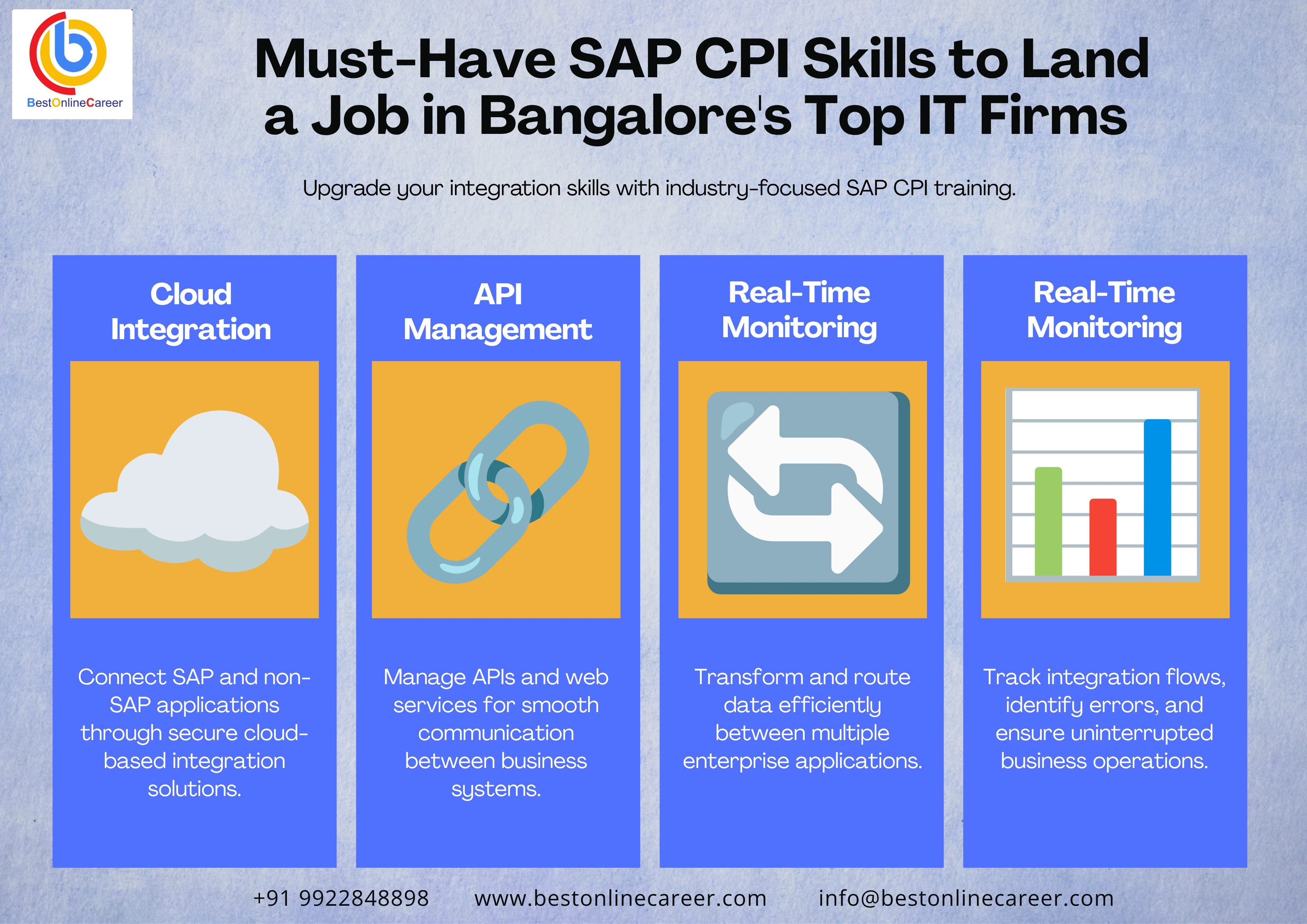
Must-Have SAP CPI Skills to Land a Job in Bangalore's Top IT Firms
Understanding the SAP CPI Landscape in Bangalore
Bangalore, often called the Silicon Valley of India, is home to a dense concentration of IT companies, global delivery centers, and technology-driven enterprises. Among the technologies accelerating digital transformation across these organizations, SAP Cloud Platform Integration — commonly known as SAP CPI — has become one of the most sought-after skills in the current job market.
SAP CPI is a cloud-based integration platform that enables businesses to connect applications, systems, and data sources across both on-premise and cloud environments. As part of the SAP Business Technology Platform (BTP) ecosystem, it plays a central role in ensuring seamless data flow across enterprise landscapes.
Demand for SAP CPI professionals in Bangalore is being driven by large-scale S/4HANA migration projects, the RISE with SAP program, and growing adoption of hybrid cloud environments. Companies including Infosys, Deloitte, Bosch, PwC, Mercedes-Benz R&D, and SAP Labs are actively hiring CPI-certified professionals in the city.
Whether you are entering the SAP ecosystem for the first time, looking to upgrade your existing skills, or transitioning from SAP PI/PO to cloud-based integration, this guide covers the skills, certifications, and tools you need to remain competitive.
Core Technical Skills Every SAP CPI Candidate Must Have
Technical proficiency is the foundation of every SAP CPI job description in Bangalore. Hiring managers consistently look for candidates who demonstrate hands-on experience with the platform's core components.
iFlow Design and Development
Integration Flow (iFlow) design is the most essential skill in SAP CPI . An iFlow is a visual representation of how data moves between systems, and every CPI developer must be able to build, deploy, and configure iFlows effectively. Employers expect familiarity with message routing, content modifiers, splitter patterns, aggregators, and multicast configurations.
Candidates who can clearly explain their iFlow design decisions during technical interviews consistently stand out from the competition.
Adapter Configuration
SAP CPI supports a wide range of adapters for connecting to different platforms and systems. The adapters most commonly tested in Bangalore interviews include SFTP, SOAP, REST, HTTP, IDoc, JDBC, JMS, OData, and Mail. Knowing how to configure these adapters is not enough — you also need to understand when each adapter is the appropriate choice based on specific business requirements.
A solid grasp of sender and receiver adapter settings, including connection parameters and security configurations, is essential.
Message Mapping and Data Transformation
Mapping and transformation skills are evaluated in the majority of SAP CPI interviews in Bangalore. You should be comfortable with graphical mapping using CPI's built-in editor, XSLT mappings for complex transformation logic, and Groovy or JavaScript scripting for dynamic data manipulation. Handling multiple message formats including XML, JSON, CSV, and EDI is an additional advantage.
Groovy Scripting
Groovy scripting has become one of the primary differentiators between strong and average CPI candidates. Groovy scripts are used within CPI to manage dynamic headers, handle custom errors, transform payloads, and implement complex business logic that cannot be achieved through graphical mapping alone.
Bangalore employers frequently ask candidates to write or review Groovy-based scripts during technical interview sessions. Practice writing scripts to read and set message headers, modify body content, call external APIs, and handle exceptions gracefully.
Error Handling and Exception Management
Error handling knowledge separates professionals with real project experience from those with only theoretical understanding. You must know how to read Message Processing Logs, configure retry mechanisms, set up dead letter queues, and create alerting workflows to notify teams about integration failures. Organizations running business-critical processes on CPI require experts who can ensure high availability and fast fault recovery.
Security Configuration in iFlows
Security configuration within iFlows is tested regularly in Bangalore interviews. This includes handling CSRF tokens, configuring message-level security, and ensuring that data transmitted through integrations is properly encrypted and decrypted using the correct certificates and credentials.
SAP BTP and Cloud Skills That Improve Hiring Chances
SAP CPI does not function in isolation. It sits within the broader SAP Business Technology Platform ecosystem, and Bangalore employers increasingly expect CPI professionals to have working knowledge of surrounding BTP services. Combining BTP skills with CPI expertise can improve shortlisting chances and support a stronger salary position.
The SAP BTP Integration Suite brings together CPI, API Management, Open Connectors, Integration Advisor, and Trading Partner Management. While deep expertise in all areas is not required, understanding how these services complement each other and when each is appropriate demonstrates architectural maturity that hiring managers value.
API Management knowledge is particularly useful. Many Bangalore projects involve exposing CPI-built integrations as managed APIs, with policies for rate limiting, authentication, and analytics. Basic familiarity with SAP API Management gives you an advantage over candidates who know only CPI. Knowledge of SAP Event Mesh and asynchronous integration using JMS adapters and message queues is also growing in relevance as enterprises move toward event-driven architectures.
SAP Cloud Connector Setup and Configuration
The SAP Cloud Connector is one of the most practical and frequently tested topics in Bangalore SAP CPI interviews. It acts as a reverse proxy that enables secure communication between on-premise systems and cloud-based BTP services without requiring inbound firewall ports to be opened.
As a CPI professional in Bangalore, you must know how to install and configure the SAP Cloud Connector on a local or virtual machine, create system mappings to expose backend systems securely, configure access control lists, and monitor the connector for connectivity issues. Many large Bangalore enterprises in manufacturing, banking, and retail still run core SAP ERP systems on-premise while moving integration middleware to the cloud, making Cloud Connector knowledge highly practical.
Troubleshooting Cloud Connector issues is also a topic that appears frequently in senior-level interviews. Be prepared to explain common connectivity errors, certificate validation failures, and how to use Cloud Connector logs to diagnose problems.
SAP S/4HANA Integration Knowledge
One of the biggest drivers of SAP CPI demand in Bangalore is the ongoing wave of S/4HANA migration projects across enterprises. Organizations upgrading from SAP ECC to S/4HANA need integration professionals who understand how CPI fits into the broader migration landscape.
You should understand the key differences between BAPI-based integration in ECC and the OData and API-first approach in S/4HANA, and know when IDoc-based communication is appropriate versus when OData APIs are preferred. Familiarity with the RISE with SAP model and how CPI is positioned within it allows you to speak confidently about integration modernization in interviews and client discussions.
Ready to Start Your Learning Journey?
Join thousands of learners and build your future with expert-led courses and 100% practical training.
Expert Guidance
Learn from industry experts
Trusted & Recognized
Top-rated by learners
Flexible Learning
Online options
Placement Support
Career support & more
Knowledge of common S/4HANA integration scenarios — including order-to-cash, procure-to-pay, financial postings, and HR data replication — combined with an understanding of how iFlows are designed to support these processes gives you a clear advantage in Bangalore's S/4HANA-driven job market.
Security Skills That Every SAP CPI Professional Needs
Security is a core requirement in SAP CPI, not an optional topic. Bangalore employers in BFSI, healthcare, and government sectors place significant importance on security-conscious integration professionals.
- Authentication and Authorization: Understand the differences between Basic Authentication, OAuth 2.0, Client Certificate-based authentication, and Principal Propagation, and know when to apply each based on system and security requirements.
- Keystore Management: Know how to import SSL certificates and SSH keys into the CPI tenant, configure SFTP connections using SSH key pairs, troubleshoot certificate expiry errors, and follow certificate lifecycle best practices.
- Credential Store and Secure Parameters: Externalize sensitive values such as usernames, passwords, and tokens outside of iFlow design using security artifacts. This is considered a best practice and is expected by all leading Bangalore employers.
- Message Level Security: Awareness of XML digital signing, XML encryption, and PGP encryption and decryption is valuable for specialized roles, particularly in regulated industries.
Soft Skills and Professional Competencies That Matter
Technical knowledge alone is rarely sufficient to land and succeed in an SAP CPI role in Bangalore. Professional competencies consistently influence hiring decisions when technical qualifications are otherwise comparable.
- Requirement Gathering and Stakeholder Communication: The ability to ask the right questions, translate business requirements into technical specifications, and communicate design decisions clearly becomes increasingly important as you progress in your career.
- Documentation Skills: Writing clear Functional Specification Documents, Technical Design Documents, and Integration Test Plans is a professional expectation in large Bangalore enterprises. Well-structured documentation reduces project risk and reflects professional standards.
- Problem-Solving and Analytical Thinking: Integration projects regularly involve unexpected issues — mismatched data formats, timeout errors, adapter connectivity failures, and performance bottlenecks. Employers value professionals who approach problems methodically and implement durable solutions.
- Agile and DevOps Awareness: Understanding sprint-based delivery, daily standups, and Git-based version control for CPI artifacts shows that you can work effectively in modern project environments.
- Team Collaboration and Mentoring: Senior CPI professionals in Bangalore are expected to guide junior developers, contribute to architecture reviews, and support team knowledge sharing through documentation and internal training.
Certifications That Strengthen Your SAP CPI Profile
Certifications demonstrate validated knowledge and can meaningfully strengthen your profile, particularly in competitive hiring situations in Bangalore.
- SAP Certified Associate — SAP Integration Suite: The most directly relevant credential for CPI professionals. It validates foundational knowledge of iFlow design, adapter configuration, message mapping, and error handling and is recognized by virtually every Bangalore company hiring in this space.
- SAP BTP Developer Certification: Valued for mid to senior-level roles, this certification demonstrates a broader understanding of the SAP Business Technology Platform beyond CPI and is associated with higher-responsibility positions.
- SAP S/4HANA Integration Certification: Particularly relevant for professionals working on S/4HANA migration and transformation projects in Bangalore. It complements CPI skills with deep knowledge of S/4HANA integration scenarios and is referenced in many architect-level job descriptions.
- SAP API Management Certification: Adds value for professionals targeting roles in companies that expose SAP services as managed APIs for external consumption.
SAP certifications can be pursued through the SAP Learning Hub, which offers both free learning journeys and paid certification exam access. Many Bangalore employers reimburse certification costs for employees, so it is worth reviewing your company's training policy before investing independently.
Tools and Technologies to Learn Alongside SAP CPI
Proficiency in CPI alone is not sufficient in today's Bangalore job market. Employers expect integration professionals to be comfortable with a range of supporting tools used throughout the project lifecycle.
- Postman: The most widely used tool for testing REST APIs in CPI projects. Know how to create API collections, set up environment variables, write pre-request scripts, and validate API responses.
- SOAP UI: Used for testing SOAP-based web services, which remain common in legacy system integrations. Familiarity with creating SOAP requests, reading WSDLs, and validating response payloads is a practical day-to-day skill.
- Git and GitHub: Essential for version control of CPI artifacts, scripts, and configuration files. Basic proficiency in Git commands, branching strategies, and pull request workflows is expected in most Bangalore development environments.
- JIRA and Confluence: Standard project management and documentation platforms in Bangalore IT companies. Knowing how to manage tasks, log work, write technical wiki pages, and participate in sprint ceremonies makes you immediately productive on any project.
- SAP Integration Advisor: A cloud-based tool within the BTP Integration Suite that helps generate mapping guidelines and runtime artifacts for B2B integration scenarios. Awareness of its purpose and appropriate use cases reflects current SAP tooling knowledge.
- SAP Cloud ALM: Increasingly used in Bangalore enterprises for monitoring and managing cloud integration landscapes. Basic knowledge of how CPI integrates with Cloud ALM for alerting and performance monitoring is a differentiator at senior levels.
Skill-Level Roadmap for SAP CPI Jobs in Bangalore
Understanding which skills to prioritize at each stage of your career helps you invest your learning time effectively and set realistic expectations for your job search.
Fresher Level (0 to 2 Years)
At this stage, the goal is to build a strong foundation. Set up a free SAP BTP Trial account and practice iFlow creation, adapter configuration, and basic message mapping. Complete the SAP Integration Suite learning journey on the SAP Learning Hub and aim for the Associate-level certification. Become proficient with the most commonly used adapters — HTTP, SFTP, SOAP, and IDoc — and practice creating basic Groovy scripts. Build a small personal portfolio that demonstrates your ability to design end-to-end integration scenarios in a test environment.
Mid-Level (2 to 5 Years)
At this stage, the focus should shift toward depth and breadth. Develop advanced Groovy scripting skills, work through complex mapping scenarios, and gain experience with exception handling and security configurations. Practice hands-on Cloud Connector setup and S/4HANA integration scenarios. Explore the fundamentals of API Management and Event Mesh within BTP. If you have a background in SAP PI/PO, position yourself for migration projects, which are in high demand across Bangalore. The BTP Developer certification is worth pursuing to differentiate your profile.
Senior and Architect Level (5 or More Years)
At senior and architect levels, value is demonstrated through architectural thinking and leadership. You should be able to design end-to-end integration architectures, oversee standardization across teams, lead PI/PO to CPI migration programs, and mentor junior developers. Deep knowledge of the BTP Integration Suite, CI/CD practices for CPI deployments, and performance optimization positions you for architect, lead consultant, and principal consultant roles at the highest compensation levels in Bangalore.
How to Present These Skills to Bangalore Recruiters
Having the right skills is only part of the equation. Communicating those skills effectively to Bangalore hiring managers and recruiters is equally important.
Resume
Tailor your resume specifically for SAP CPI roles. Use keywords drawn from job descriptions — such as iFlow, BTP, Groovy, adapter configuration, S/4HANA integration, and OAuth. Describe specific integration scenarios you have worked on rather than using generic summaries. Quantify your experience wherever possible, including the number of iFlows developed, volume of messages processed, or the number of systems integrated.
LinkedIn Profile
Optimize your LinkedIn profile with CPI-specific keywords in your headline, summary, and skills section. Bangalore recruiters actively search for terms like SAP CPI, SAP BTP Integration, SAP Integration Suite, and iFlow developer. Ensure your profile appears in these searches by incorporating relevant keywords naturally throughout your profile content.
Portfolio and Community Presence
A GitHub portfolio containing examples of iFlow configurations, Groovy script libraries, and documentation can set you apart from other applicants. Even sample projects created in a trial environment demonstrate technical capability and code quality. Active participation in the SAP Community Network and LinkedIn — through writing technical posts, answering questions, or sharing CPI experiences — increases your visibility to Bangalore recruiters and establishes your credibility as a practitioner.
Interview Preparation
Prepare to walk through real integration scenarios from your experience, explain your design decisions, and write or interpret Groovy scripts on the spot. Practice explaining technical concepts in plain language. The ability to communicate clearly and concisely is something Bangalore employers consistently evaluate alongside technical depth.
Ready to land your ideal SAP CPI job in Bangalore? Sign up now to learn iFlow design, Groovy scripting, BTP Integration, and S/4HANA — and walk into top IT company interviews with confidence. Join our WhatsApp channel for SAP CPI updates, job openings, interview questions, and daily learning tips.
Related SAP Training Courses
Tags
Share this article
Help others discover this valuable SAP content