
OData in SAP ABAP on Cloud: Building Cloud-Ready Services with RAP
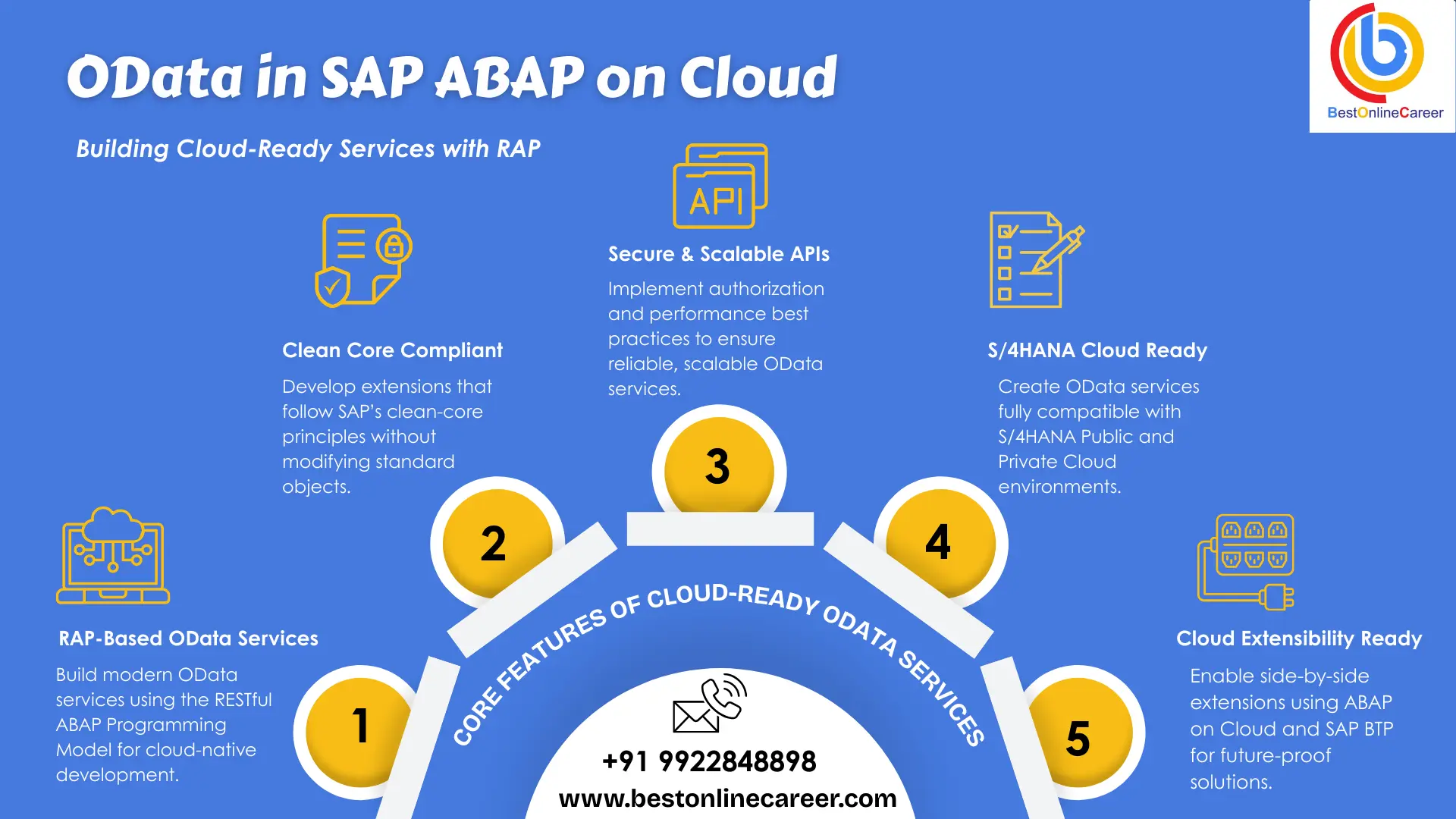
OData in SAP ABAP on Cloud - Building Cloud-Ready Services with RAP
The advanced stages in SAP development have reached another turning point with ABAP on Cloud and the ABAP RAP (RESTful Application Programming Model). With OData (Open Data Protocol), we will learn how OData can assist in building modern services that leverage the cloud.
For scalable and sustainable enterprise application development, there is a future OData in SAP ABAP applications that need to be OData enabled.
What is OData in SAP ABAP?
An example of a standard RESTful protocol that can be utilized for the consuming and building of SAP APIs is OData. In SAP ABAP, the OData separates the backend logic from the frontend applications, and is able to move data across the various platforms, for seamless integration.
Since OData uses the available HTTP protocol methods (GET, POST, DELETE, PUT, and PATCH), there can be a full range of CRUD operations on the various objects in the business data.
The metadata information that is available for the different OData services makes descriptions of the data entities that are available, provide a concise document that describes the available entities, point out the various properties, and describe the numerous associations.
This self-describing capability makes the pre-integration and on-the-go development a less time consuming process. In OData there are plenty of advanced query options that enable filtering of data, sorting, pagination, and even the selection of data that a developer needs to pull out.
Traditional vs Modern OData Development
Traditional Approach
In older versions of SAP systems, the OData services were built by the developers using the SAP Gateway framework using Transaction SEGW. Some of the steps included creating Data Provider Classes (DPC) and Model Provider Classes (MPC).
This is a tedious and time consuming process that requires the manual implementation of each individual operation. This involved manually coding each of the GET_ENTITY, GET_ENTITYSET, CREATE_ENTITY, UPDATE_ENTITY, and DELETE_ENTITY methods.
Modern RAP Approach
With the introduction of ABAP on Cloud, there is a major change with RAP, which is built to automate most of the OData service generation. With RAP, you are required to configure the Core Data Services (CDS) views which will define and describe your data model, along with the behavior definitions which will specify the possible manipulations available on the data.
The framework will the OData services that will expose these definitions along with the built in standard operations and validations.
Building OData Services with RAP
Step 1: Define Your Data Model with CDS Views
Every RAP service is built around a CDS view where you define your source of data:
Example CDS View:
- Define access control and user text labels
- Select from your database table (zsalesorder)
- Map key fields like order_id, customer_id, order_date
- Include fields such as total_amount, currency, and status
Step 2: Create Behavior Definition
The next step is creating behavior definitions which describe what actions can be performed on your entities:
- Use managed implementation in class
- Define persistent table and lock master
- Enable create, update, and delete operations
- Set field properties (readonly, mandatory)
- Add validation and determination logic
Step 3: Create Service Definition and Binding
The service definition is where you indicate which entities you would like to expose. Your OData service is ready as soon as you create a service binding and activate it.
The framework takes care of all the underlying aspects and sets your service to be accessible from a predefined URL.
Additional OData Features in RAP
Associations and Compositions
RAP recognizes various relationships in data. Compositions capture parent-child hierarchies, where child entities are strictly dependent on their parent.
This allows you to define relationships like sales orders with their line items, maintaining data integrity across related entities.
Actions and Functions
In addition to the four basic CRUD operations, RAP also provides the possibility of defining additional actions (which are state-changing operations) and functions (read operations only).
Examples include approving orders, calculating discounts, or executing custom business logic.
Draft Handling
In the case where user interactions are lengthy, RAP offers draft features, where users can save their progress without having to commit to the database. This is extremely important for complex business processes.
Key Considerations for ABAP on Cloud
Clean Core Principle
ABAP on Cloud enforces the clean core principle, which implies that you are not permitted to directly modify standard SAP objects. All modifications must be performed through extension points and released APIs.
This keeps your code safe from upgrades and compatible with the cloud. Only released APIs may be accessed, and the system enforces this with syntax checks.
Managed vs Unmanaged Scenarios
RAP manages both managed and unmanaged scenarios. In managed scenarios, the framework takes care of operations such as database interactions, locking, and numbering.
For cloud development, managed scenarios are highly encouraged as they are more efficient and improve consistency and maintainability.
Ready to Start Your Learning Journey?
Join thousands of learners and build your future with expert-led courses and 100% practical training.
Expert Guidance
Learn from industry experts
Trusted & Recognized
Top-rated by learners
Flexible Learning
Online options
Placement Support
Career support & more
Authorization
Authorization is fully embedded in RAP. You have the flexibility to incorporate both field-level and instance-level authorization that will automatically trigger whenever users venture into your OData services.
This maintains the integrity of security on all access pathways.
SAP ABAP OData Interview Questions
Q1: What is the difference between OData V2 and OData V4 in SAP?
OData V2 was considered the default standard for SAP Fiori applications, while OData V4 was considered the up-and-coming standard that was more in line with ABAP on Cloud and RAP.
OData V4 uses a more streamlined URL and introduces more effective batch processing. With regard to the variety of filtering and querying capabilities with the use of expressions, it is also considered more advanced than previous versions.
RAP prefers OData V4 over other versions, especially for performance improvement in areas like delta responses. This is mainly because the managed approach RAP favors is in alignment with OData V4.
Q2: What mechanisms are used by RAP to automatically create OData services?
In RAP, Metadata-Driven models try to combine the behavioral and service definitions to create the OData services automatically. When service binding is created and subsequently activated, the framework inspects the annotations in the respective CDS, along with the behavioral definitions, and generates the OData metadata as well as the implementation for runtime.
The framework does the mapping of CDS entities to the OData entity types, associations to the navigation properties, and behaves the operations to OData actions and functions – washing away the need for any DPC or MPC classes.
Q3: What is the role of transactional behavior in RAP?
In RAP, the transactional behavior is framed for the purpose of data consistency, and is the result of the Late Numbering and the Phase-Based Processing. The RAP framework behaves differently, as in, instead of writing to the database straight away, RAP holds all the changes in an internal buffer.
After prompting the RAP framework to save, a particular sequence of validations, determinations, and authorizations is then executed. If all the positive checks pass, only then is the transaction committed.
This facilitates improved error management or handling, rollbacks, and the functionalities for more sophisticated or complex business logic.
Q4: How to implement custom business logic in RAP-based OData services?
In RAP, custom business logic is executed in the behavior implementation classes that match your behavior definitions. These classes are integrated with logic for the different types of CRUD operations such as validation, determination, and action.
Validations are the business rule checks that raise message errors when the conditions are not fulfilled. Determination is the logic that sets and calculates the value of a field based on other available values.
Actions are used to implement any custom business rules that are not standard CRUD operations. These logic layers are customized to your business rules. RAP transactional processing integrates with all of these CRUD operations, and OData services will automatically expose these changes.
Q5: How does authorization work in RAP OData services?
Authorization logic in RAP can be implemented at different levels. With instance-based authorization, the system checks whether a user should be able to access a specific record based on its content.
With global authorization, the system checks whether a user should be able to perform an operation at all. These logic layers are defined in behavior definitions and implemented in the behavior pool.
This is the reason the framework will run these logic layers for authorization before any other operation to ensure that all the security measures have been taken in all available access points.
Performance Optimization for OData Services
Minimize Data Transfer
Data transfer can be minimized by using OData query options, such as select and expand, to only request the data in the fields and entities that are needed. This will reduce the size of the payload and improve response times.
Filter logic should be pushed down to the database using CDS views instead of filtering in the ABAP code, as this utilizes database optimization more effectively.
Use Batch Requests
To minimize the number of network round trips, use batch requests for operations on multiple entities. Enhanced batch processing, available in OData V4, is automatically supported by all RAP services.
Implement Caching Strategies
For data that does not change often, use caching strategies with HTTP cache headers. RAP services support ETag-based optimistic locking, which can be used for cache validation.
Testing OData Services
Testing OData services using the SAP Gateway Client is helpful because you can create OData queries without building a separate user interface.
SAP OData services work well with modern API testing tools, such as Postman, allowing for the creation of sophisticated test suites that cover all CRUD operations and all possible error conditions and edge cases.
ABAP Unit tests can be used to validate RAP behaviors, ensuring that the underlying business logic is maintained throughout modifications.
OData's Future in SAP
With SAP's ongoing cloud transformation, RAP and OData V4 are the strategic frameworks moving forward for all new developments. Modern development techniques emphasized by ABAP Cloud guarantee the maintainability, scalability, and cloud-readiness of applications.
Understanding OData within this framework means embracing a new development philosophy that will be the standard for SAP development for years.
Conclusion
OData within SAP ABAP has streamlined from a Gateway development process that involved a lot of manual work to fully automated, and metadata driven, RAP. For ABAP developers in Cloud environments, the development of OData services based on RAP is crucial.
CDS views, behavior definitions, and service bindings offer a unique combination that empower developers to easily create robust, enterprise-level APIs. Whether you are preparing for interviews, developing new cloud-based applications, or upgrading existing services, grasping these concepts will help you succeed in SAP today.
Related SAP Training Courses
Tags
Share this article
Help others discover this valuable SAP content


