Top SAP Fieldglass Trends & AI Features in 2026
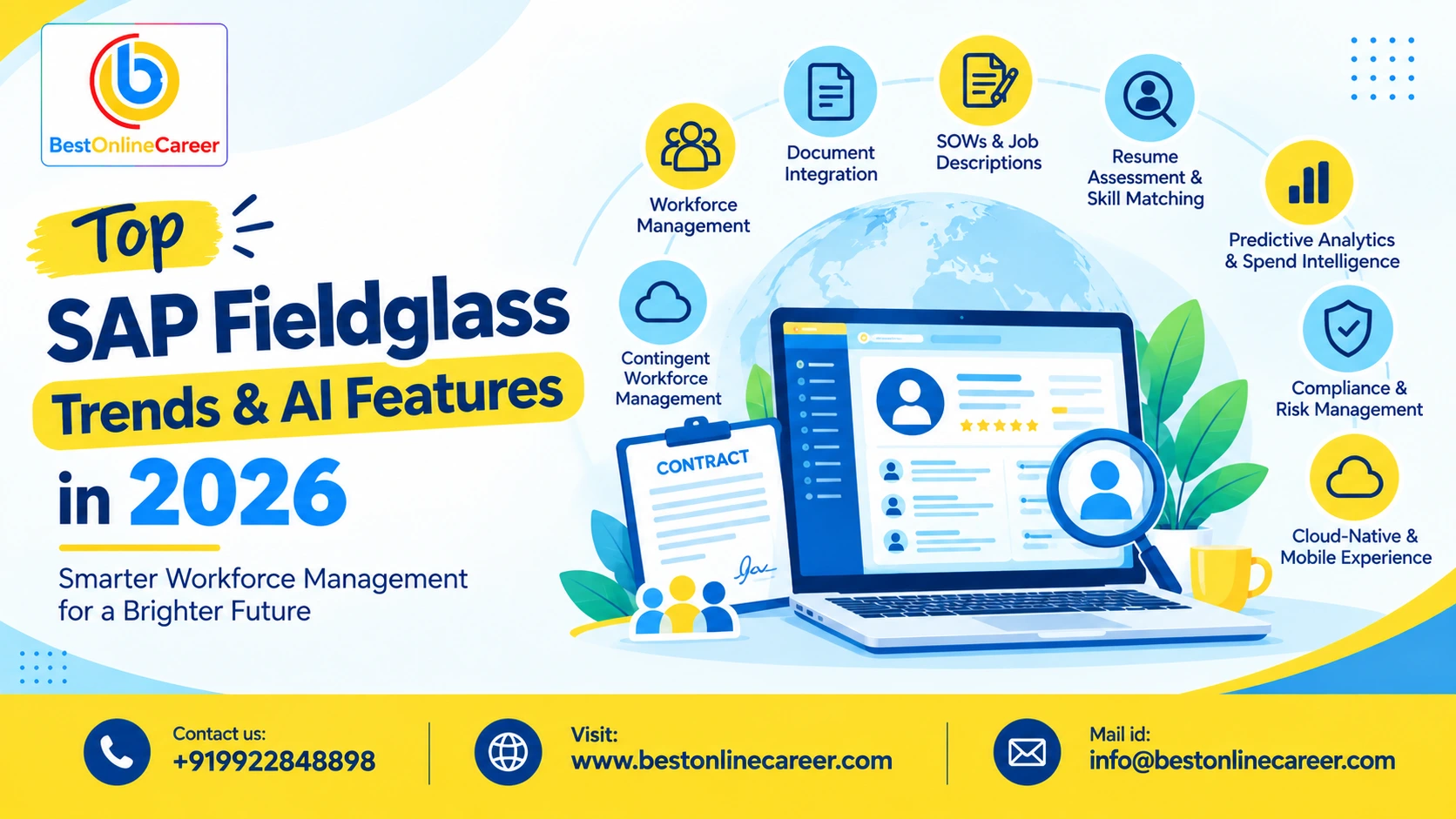
Top SAP Fieldglass Trends & AI Features in 2026
Contingent workforce management · Vendor Management System (VMS) · SAP Business AI
Enterprises are no longer able to view contingent labor as a secondary conversation. Consultants, contractors and freelancers as well as statement of work (SOW) related services comprise a significant portion of the way work is done, and the systems that manage this workforce have needed to expand rapidly. SAP Fieldglass sits at the middle of this shift, and 2026 has turned into an extremely significant year in the platform's history. SAP has introduced an unusually large amount of AI capabilities in the product, including skills-based matching, conversational AI via Joule, automated SOW generation, and document intelligence — all of which aim to cut the manual effort involved in the process of sourcing, contracting and coordinating external talent. This article will explain the reasons for this shift in SAP Fieldglass trends, what's new in AI-powered vendor management systems, and what this means for those who use the platform on a daily basis.
What is SAP Fieldglass?
Understanding SAP Fieldglass
SAP Fieldglass SAP Fieldglass is a cloud-based Vendor Management System (VMS) that assists organizations in sourcing, managing and paying their outside workforce, which includes contractors, contingent workers, freelancers, and other services that are sourced by way of statements of work. Instead of managing this work using Excel spreadsheets, email chains, or other disconnected supplier portals, Fieldglass gives procurement, finance and HR teams a single platform to handle requisitions, timesheets, supplier relationships, invoices, and compliance throughout the entire lifecycle of non-employee workers. According to recent industry reports, Fieldglass operates in more than 180 countries and supports invoicing across 118 of them, making it one of the largest contingent workforce management platforms of its kind in terms of transaction volume. Because it's part of the wider SAP Business Network and integrates with SAP Ariba, it also connects contingent workforce management with the same supplier ecosystem that companies already use for direct and indirect procurement.
Why SAP Fieldglass is Evolving in 2026
Digital Workforce Transformation
The workforce of today is multi-faceted in a variety of senses — a mix of full-time employees, contractors, freelancers and services vendors, frequently working across time zones and geographical locations. Companies need to be aware of every aspect of the workforce, not just the total number of payroll employees. This pressure is driving VMS platforms such as Fieldglass to evolve continuously rather than relying on occasional large releases, introducing intelligence layers that make it easier to identify, source and manage this diverse workforce as a single source of talent.
Rise of AI in Procurement
Procurement is now one of the top areas of application for AI within SAP's portfolio. Instead of AI being a bolt-on feature, it's becoming the standard method of running procurement processes, from how spend requests are classified to how contracts are written. Fieldglass, SAP's services and contingent labor procurement system, is the perfect spot for this AI in procurement investment to take off, and 2026 has seen SAP accelerate the process of transforming AI pilots into high-quality workflows that cover intake, contracting and supplier management.
Demand for Contingent Workforce Management
Economic uncertainty, a shortage of skilled workers, and the requirement for workforce flexibility have led to contingent work becoming an integral part of company strategy, rather than a temporary solution. As the complexity and volume of the workforce increase, manual methods of managing and sourcing it will cease to scale. Companies are looking for tools that find the best talent for the job more efficiently and with less administrative burden — exactly the gap that AI-driven matching and automation is designed to bridge.
Growing Adoption of SAP Business AI
SAP Business AI can be described as the umbrella for Joule agents, agentic automation, and generative AI capabilities being implemented across the complete SAP suite of products — SAP S/4HANA, Ariba, SuccessFactors, and Fieldglass as well. As the adoption of Joule AI grows across dozens of SAP solutions, Fieldglass customers are getting firsthand experience with AI agents and conversational AI as part of their routine, rather than as an experimental add-on feature.
Top SAP Fieldglass Trends in 2026
AI-Powered Workforce Management
Intelligent Workforce Planning
Businesses are increasingly using AI in Fieldglass to anticipate rather than react — forecasting when skill gaps will appear, which positions are the most difficult to fill, and how contingent labor spend is evolving across different business units. This shifts workforce planning from a reactive, requisition-by-requisition exercise to something closer to strategic capacity planning.
Automated Candidate Matching
One of the most important capabilities available in 2026 is AI-based skills matching. Once a job requisition has been created, the system examines the job description to determine the competencies required and then matches contractors to that profile. SAP estimates that this could reduce the time it takes to find qualified candidates by around half, allowing hiring teams to concentrate on strategic, skill-based decisions instead of manually screening resumes.
SAP Joule AI Integration
AI Assistant for Faster Hiring
Joule, the SAP AI copilot, has been integrated into Fieldglass workflows to help speed up hiring. Instead of navigating through several screens to create requisitions or check their status, users can engage with Joule conversationally to move tasks forward faster, letting the assistant pull the appropriate information automatically.
Natural Language Queries
Joule lets users ask questions in plain language about workforce data — such as spend by category, supplier performance, or requisition status — instead of manually building reports. As Joule expands across SAP's solutions portfolio, this natural-language interface has become an established way of interacting with Fieldglass data, not a new feature.
AI-Generated Job Descriptions
Create Better Job Posts in Seconds
Fieldglass now comes with generative AI tools that can create precise, organized job descriptions using minimal input, helping hiring managers avoid inconsistent or unclear postings that slow down the hiring process.
Multi-language Job Description Translation
Since most Fieldglass customers operate globally, AI-powered translation lets an entire job description be translated into multiple languages rapidly, ensuring consistent hiring standards across regions without manual rewriting.
AI-Based Statement of Work (SOW) Creation
AI-Generated SOW Descriptions
Historically, defining a worker's deliverables and scope in a statement of work was a manual and often inconsistent process that could delay projects. SAP has introduced AI capabilities that can generate SOW deliverables and role descriptions instantly, with SAP reporting a substantial 70 percent reduction in the manual work required to create these documents.
AI Role Recommendations
In addition, the system can now suggest appropriate roles for workers by analyzing the SOW name, description, and historical data from previous SOWs and buyers, making it easier for hiring managers who aren't procurement experts themselves.
Machine Learning for Resume Assessment
Skill Matching
Machine learning models analyze resumes against job-specific requirements to surface the most relevant skills for a particular role, instead of relying solely on keyword matches.
Experience Assessment
Beyond skills, the system also evaluates relevant experience — project history, industry background, and time in role — giving hiring managers a more accurate picture of candidate fit.
Qualification Recommendations
AI can also identify qualifications or certifications that may be relevant but weren't explicitly mentioned, helping recruiters surface high-quality candidates who might otherwise be overlooked.
SAP Document AI Integration
Automated SOW Creation
Document AI capabilities enhance SOW creation by automating document processing and structuring, producing ready-to-use statements of work and reducing the back-and-forth typically required to finalize contract language.
Intelligent Document Processing
More broadly, Document AI is being used to interpret and extract data from unstructured documents such as contracts and compliance paperwork, turning material that previously required manual review into data the system can process directly.
Predictive Analytics & Spend Intelligence
Supplier Performance Analytics
Fieldglass is increasingly using analytics to track and score supplier performance over time, helping procurement teams make renewal and sourcing decisions based on data rather than anecdotes.
Workforce Cost Forecasting
Predictive models help procurement and finance teams anticipate trends in contingent workforce spend, supporting more precise budgeting and reducing the risk of unplanned cost overruns.
Compliance & Risk Management
Automated Compliance Checks
As regulatory requirements for contingent labor — worker classification, tax status, data privacy — grow more complex across jurisdictions, AI-driven compliance checks help detect issues before hiring rather than after a worker is already engaged.
Worker Qualification Validation
The platform also supports automatic validation of worker qualifications and certifications, which is especially important in highly regulated industries where non-compliance can carry serious safety or legal consequences.
Enhanced Services Procurement
AI-Assisted Services Procurement
The services procurement space — covering project-based, outcome-driven work rather than pure staffing — is now receiving more AI assistance, including supplier evaluation and SOW-based sourcing, an area SAP has highlighted as a strength in recent industry recognition.
Faster Approval Workflows
Joule-driven automation is being used in approval chains, helping route requisitions, SOWs, and invoices to the right approvers faster and with fewer manual escalations.
Cloud-Native & Mobile Experience
Improved User Experience
SAP has partnered with adoption tools like WalkMe to guide users step-by-step through common Fieldglass tasks such as creating and revising SOWs and approving timesheets — particularly useful during system updates or new feature rollouts.
Latest AI Features in SAP Fieldglass (2026)
Ready to Start Your Learning Journey?
Join thousands of learners and build your future with expert-led courses and 100% practical training.
Expert Guidance
Learn from industry experts
Trusted & Recognized
Top-rated by learners
Flexible Learning
Online options
Placement Support
Career support & more
- AI Job Description Generator
- AI Translation for Job Descriptions
- AI SOW Description Generator
- AI Resume Assessment
- AI Skill Highlighting
- AI Experience Assessment
- AI Qualification Matching
- SAP Joule AI
- SAP Document AI
- AI Role Recommendations
- AI Data Governance & Management
Benefits of AI in SAP Fieldglass
- Faster Hiring Process — automated matching and AI-written job descriptions reduce the gap between requisition and placement.
- Improved Candidate Selection — skills and experience-based matching reduce the need for manual resume screening and also limit unconscious bias.
- Enhanced Procurement Efficiency — AI-generated SOWs and role suggestions reduce administrative burden for hiring managers and procurement teams alike.
- Lower Operational Costs — less manual document creation and fewer sourcing delays translate directly into lower administrative cost per hire.
- Improved Compliance — automated checks catch qualification and classification issues earlier, limiting exposure to regulatory risk.
- Improved Productivity — teams spend less time on repetitive administrative tasks and more time on important workforce decisions.
- Smarter Decision-Making — predictive analytics and spend intelligence give managers a more precise, evidence-based view of workforce trends.
Real-World Business Use Cases
SAP Fieldglass vs Traditional Workforce Management
| Dimension | Traditional Approach | SAP Fieldglass (2026) |
|---|---|---|
| AI Capabilities | Manual screening and matching | AI-driven skills matching, résumé assessment, SOW generation |
| Automation | Spreadsheet- and email-based processes | Automated approvals, document processing, compliance checks |
| Compliance | Manual audits, reactive risk management | Automated qualification validation and compliance checks |
| Analytics | Static, backward-looking reports | Predictive spend and supplier performance analytics |
| Scalability | Difficult to scale across geographies | Cloud-native platform supporting 180+ countries and 118 invoicing markets |
Career Opportunities in SAP Fieldglass
As adoption increases, so does the demand for professionals who know the platform:
With AI features growing exponentially, professionals who understand both the functional side of Fieldglass and its AI capabilities are becoming more valuable — this is no longer just a configuration skill set, but one that can influence procurement strategy, compliance, and data analytics.
Learn SAP Fieldglass Online
Who Should Learn SAP Fieldglass?
This career path is ideal for procurement professionals, HR practitioners, SAP consultants looking to specialize, and career changers looking to move into contingent workforce and procurement technology.
Course Curriculum
A well-structured Fieldglass training program typically covers Fieldglass fundamentals, requisition and SOW management, worker and supplier administration, analytics and reporting, and increasingly incorporates AI and Joule capabilities now built into the platform.
Certification Preparation
Structured training should align with SAP's certification programs, giving learners a credential that's recognized by employers and SAP implementation partners.
Live Project Training
Hands-on experience with real or simulated implementation scenarios helps students understand how Fieldglass operates in practice, not just in the abstract — configuration decisions, approval workflows, and edge cases rarely show up on slide decks.
Career Support
Effective training programs combine platform training with resume development, interview preparation, and placement guidance, recognizing that landing your first Fieldglass job is usually the hardest step.
Frequently Asked Questions
What is new in SAP Fieldglass 2026?
In the 2026 cycle, SAP SAP added AI-powered skills-based matching, more advanced SAP Joule integration for conversational workflows, automated SOW generation using Document AI, and expanded analytics and compliance capabilities — described by SAP as among its most AI-intensive releases to date.
Does SAP Fieldglass use AI?
Yes. AI is now embedded in hiring, resume evaluation, SOW creation, job description generation, and compliance checking, with SAP Joule providing a conversational interface across these areas.
What is SAP Joule in SAP Fieldglass?
Joule is SAP's AI-powered copilot, integrated into Fieldglass to let users interact with the system through natural language — asking questions, generating requisitions, and receiving recommendations without navigating multiple traditional screens.
How does AI improve workforce management?
AI reduces the manual work involved in sourcing, matching, contracting, and compliance, allowing teams to focus on strategic decisions instead of administrative tasks, while improving accuracy and reducing bias in candidate selection.
What are the advantages of SAP Fieldglass?
Faster hiring, better candidate selection, improved procurement efficiency, lower operating costs, stronger compliance, and better decision-making through predictive analytics.
Is SAP Fieldglass a good career path in 2026?
Yes — as more businesses adopt AI-driven contingent workforce management, demand for analysts and consultants who understand both the functional and AI sides of the technology continues to grow.
What is SAP Fieldglass online training?
It's structured, usually instructor-led training covering Fieldglass configuration and workflows, increasingly including AI features, often paired with certification preparation and hands-on project work.
Who can learn SAP Fieldglass?
HR and procurement professionals, SAP consultants, business analysts, and career changers interested in workforce technology or procurement systems.
What industries use SAP Fieldglass?
Manufacturing, IT, healthcare, banking and financial services, oil and gas, and telecommunications are among the largest users, though it's used across virtually all industries with significant contingent labor needs.
How long does it take to learn SAP Fieldglass?
This depends on the depth of study, but foundational competence is usually achieved within a few weeks of formal instruction, while functional expertise typically develops over several months of applied, project-based training.
Related SAP Training Courses
Tags
Share this article
Help others discover this valuable SAP content