
SAP Fieldglass Course: Compare SAP Fieldglass vs Traditional VMS
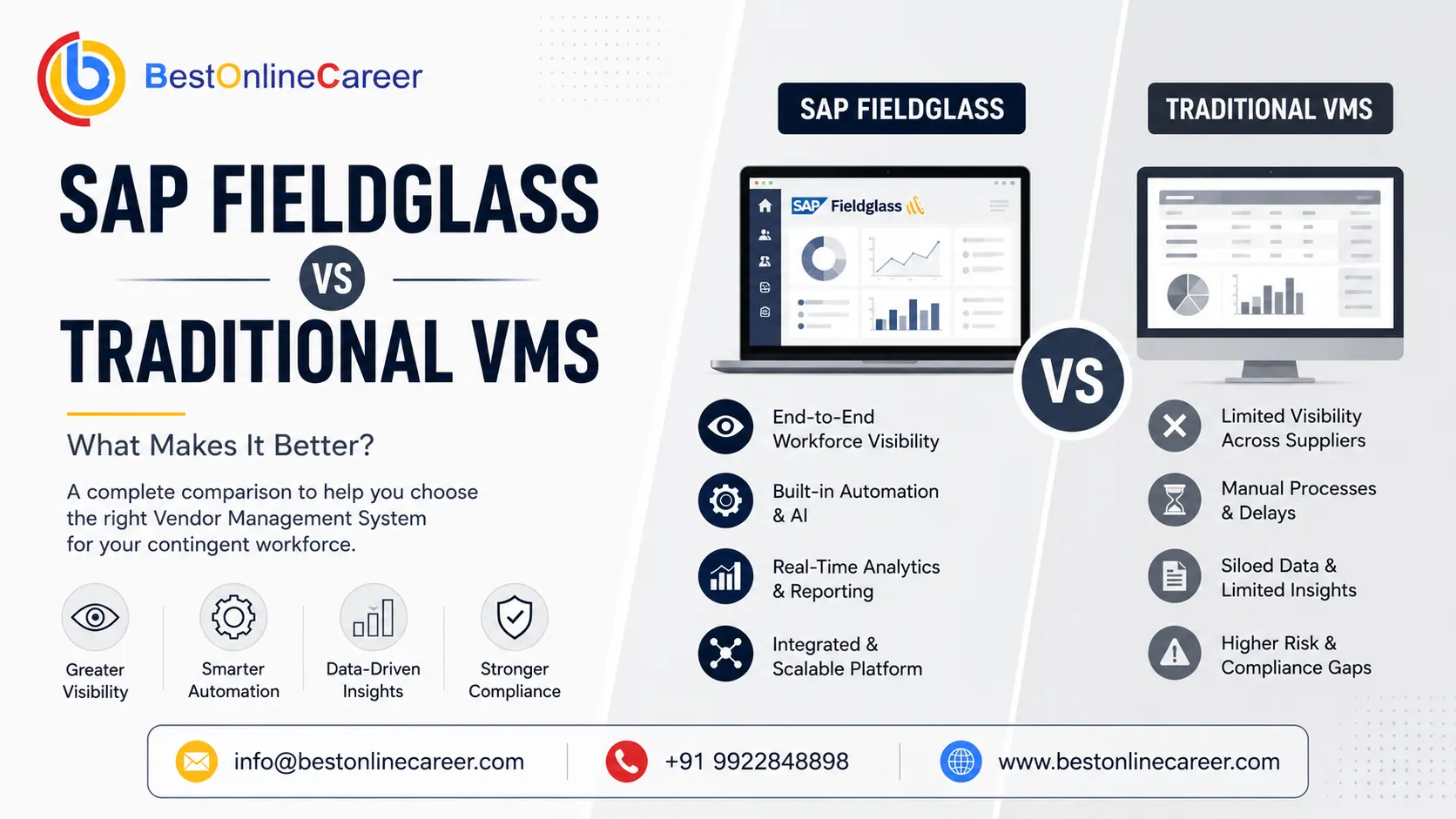
What Advantages Does SAP Fieldglass Have Over Conventional Vendor Management Systems (VMS)?
It is no longer a secondary task to manage temporary employees. It is now a critical business objective. The management of freelancers, contractors, and external service providers is now a necessary business function. This has made the choice between SAP Fieldglass Vendor Management Systems and Conventional Vendor Management Systems extremely important.
This guide is designed to help you understand the differences between SAP Fieldglass Vendor Management Systems and Conventional Vendor Management Systems, and the reasons that companies are switching, as well as the differences that good Vendor Management Systems can bring to the management of corporate Temporary Employees.
What is a Vendor Management System (VMS)?
A Vendor Management System (VMS) is an automated and proprietary system that helps organizations manage the procurement and engagement of contract workers. This includes temporary employees, independent contractors, freelancers, and vendor services.
Conventional VMS was designed in the early 2000s to simplify the procurement of temporary employees. Although these VMS were useful at the time, they are now outdated for most of the requirements of today's global, integrated workforce.
SAP Fieldglass is an advanced, cloud-based system, VMS that is built for the current, modern, temporary workforce.
What is SAP Fieldglass?
SAP Fieldglass is a comprehensive cloud-based vendor management system created by SAP SE. Fieldglass was founded in 1999 and bought by SAP in 2014. It has since become the most popular external workforce management system.
The SAP Fieldglass Solution provides the following to businesses:
- The ability to source and contract contingent labor and service providers around the globe.
- The capability to manage the full contingent labor lifecycle from requisition to offboarding.
- The ability to see and control workforce spend with compliance at the forefront.
- The ability to integrate with SAP S/4HANA, SAP SuccessFactors, and any third-party ERP systems.
The SAP Fieldglass Contingent Workforce module is scalable to the needs of the business, regardless of whether a business manages 50 or 50,000 contingent workers.
SAP Fieldglass vs Traditional VMS: A Direct Comparison
1. Cloud-Native Architecture vs Legacy Infrastructure
Most legacy vendor management systems have been built based on outdated and on-premise systems. Traditional vendor management systems create serious challenges such as:
- Elevated costs to maintain IT systems
- A slow system to implement updates
- Limited access for a global workforce or a remote workforce
- A poor experience for mobile users
SAP Fieldglass VMS has been built in the cloud. This has created:
- A system with automatic updates and no downtime
- Users can access the system at any time, from any location, using either mobile or desktop devices
- A lower total cost of ownership when compared to systems built on-premise
- A system that will scale with the needs of the organization
For organizations with a global or remote workforce, or a workforce that spans multiple time zones, a cloud-native system is not just desirable; it is a requirement.
2. End-to-End Contingent Workforce Management
Most legacy VMS platforms have a limited focus. For instance, they might focus solely on the management of staffing supply or on contractor timesheets. They typically do not provide a comprehensive view of the external workforce ecosystem.
SAP Fieldglass Contingent Workforce Management provides a truly end-to-end solution:
| Feature | Traditional VMS | SAP Fieldglass |
|---|---|---|
| Worker Requisition & Sourcing | Basic | Advanced with AI-assisted matching |
| Timesheet & Expense Management | Yes | Automated & integrated |
| Statement of Work (SOW) Management | Limited | Full lifecycle SOW tracking |
| Onboarding & Offboarding | Manual | Digitally automated |
| Global Compliance Management | Weak | Built-in multi-country compliance |
| Real-Time Analytics & Reporting | Basic reports | Predictive analytics dashboards |
| ERP Integration | Custom builds | Native SAP integration |
The comprehensive nature of SAP Fieldglass Workforce Management removes silos, providing Procurement, HR, and Finance staff with a single source of truth.
3. SAP Fieldglass Vendor Management: Enhanced Supplier Relationships
In most of the traditional systems, vendor relationships are managed manually through the use of spreadsheets, emails, and unconnected approval workflows. This results in the following issues:
- Late onboarding of suppliers
- Inconsistent rates
- Compliance failures
- Inability to assess vendor performance
SAP Fieldglass Vendor Management overturns the status quo by providing:
- A central vendor portal where vendors may submit workers, manage their profiles, and check payment status
- Automated rate card to ensure consistent and compliant billing
- Vendor scorecards and KPIs to assess performance and guide sourcing decisions
- A preferred supplier list to simplify sourcing and decrease maverick spend
This level of supplier insight is not possible with most legacy vendor management systems.
4. Compliance and Risk Management
One of the largest concerns with managing a contingent workforce is the risk of misclassifying contingent workers. Classifying a self-employed contractor as an employee (or vice versa) can result in enormous fines, back taxes, and loss of a company's good standing reputation.
Traditional vendor management system (VMS) platforms do not have the intelligence to detect compliance risks. The SAP Fieldglass Solution offers:
- Worker classification that is built within the system and is flexible to regional and international laws
- Compliance notifications to Fieldglass users when worker engagements are approaching a legal limit
- Automated compliance review documentation
- SAP GRC (Governance, Risk & Compliance) integration
For global organizations, the SAP Fieldglass compliance framework is a requirement.
5. Real-Time Analytics and Workforce Visibility
The quality of decisions made is compromised when workforce data is isolated within disparate systems. Traditional VMS platforms are cumbersome and provide outdated, inflexible, and unrevised data.
The SAP Fieldglass Workforce Management module helps employers and other authorized users with real-time data through analytic dashboards:
Ready to Start Your Learning Journey?
Join thousands of learners and build your future with expert-led courses and 100% practical training.
Expert Guidance
Learn from industry experts
Trusted & Recognized
Top-rated by learners
Flexible Learning
Online options
Placement Support
Career support & more
- Total workforce spend analytics by department, category, and region
- Worker category count by contingent worker classification
- Average duration to fill positions
- Analytics for supplier diversity to enable ESG reporting
- SAP powered analytics for workforce demand forecasting
With the above data, employers and the C-suite can make informed and strategically proactive data-based decisions.
6. Integration Ecosystem
A major shortcoming of most Traditional Vendor Management Systems is their lack of integration with the employee ecosystem and the balance of systems within the enterprise tech stack. Custom integrations are expensive, fragile, and highly dependent on IT support.
The SAP Fieldglass VMS was built for seamlessly integrated systems:
- Built-in SAP S/4HANA integrations for unobstructed financial processing
- Integrations with SAP SuccessFactors for unified total workforce management (permanent + contingent)
- Pre-built integration for major ERP, HCM, and procurement systems (including other than SAP)
- Open APIs for integrations for custom/proprietary systems
Because of this level of integration, your SAP Fieldglass Vendor Management System is fully integrated in your workforce management systems.
Who Should Use SAP Fieldglass?
SAP Fieldglass should be used for:
- Businesses that employ 500+ contingent workers in many locations globally
- Small businesses that want to run a contingent workforce program without an increase in administrative burden
- HR and Procurement divisions looking for complete and unified visibility across enterprise workforce cost
- Businesses in financial services, healthcare, and manufacturing
- Businesses that are undergoing a digital transformation, that want to have a VMS that integrates with their SAP products, and want SAP Fieldglass as their VMS
Advantages of SAP Fieldglass
These are the advantages organizations have seen after using the SAP Fieldglass Contingent Workforce Management platform:
- Lower contingent labor costs, better management of rate cards, and increasing competition among suppliers
- Workers are onboarded up to 50% faster due to the digital transformation of the workflows and the automation of the workflows
- There is almost 100% accuracy in timesheets due to the automation of timesheet approval and due to the integration of payroll
- Improved audits due to the automation of approval and due to complete digital design for every engagement
- Greater workforce agility to scale up or down as demand for labor services changes
Common Concerns About Migrating from Traditional VMS to SAP Fieldglass
"Change is hard for my team. How disruptive will this migration be?"
Upgrades include an adjustment period. User experience drives the developments in SAP Fieldglass. With the application of role-based views for procurement managers, hiring managers, and finance folks, each will have available to them only the relevant data and workflow. SAP provides application training resources, implementation support, and a robust partner ecosystem.
"We can't be a complete SAP client. Would Fieldglass still be usable?"
The answer is yes. The SAP Fieldglass VMS is purposely built to be integrated with SAP solutions to provide maximum benefits. However, through open APIs and a variety of pre-built connectors, Fieldglass readily integrates with non-SAP ERPs and HCMs. A number of companies have successfully utilized Fieldglass with Workday, Oracle, and Microsoft Dynamics.
"Can a mid-sized company afford it?"
SAP Fieldglass has a scalable subscription model. For those companies with annual spend over $5M on contingent labor, the cost of the system is recovered in the first year through the control of spend, elimination of maverick buying, and the removal of the expense of manual processing.
The Future of Contingent Workforce Management
The external workforce is the growing workforce. Contingent workforce participation is estimated to be 35–40% in most developed countries and growing. Organizations will be uncompetitive, lose business, and be unable to serve customers by VMSs which do not comply with modern practices and cost control.
SAP Fieldglass allows organizations to stay ahead of their competition with the following:
- An AI sourcing system to recommend suppliers that suit specific job requirements
- Demand-predicting analytics to understand the requirements of the workforce before business leaders bring it up
- Modern ESG initiatives are facilitated by their sustainable and diversity reporting
- Innovative, consistent product updates due to SAP's extensive global R&D
Every organization needs a modern Contingent Workforce Management system. The only query that is left is how long can you afford to wait.
Final Verdict: SAP Fieldglass Dominates the Competition
There should be no debate when looking at the SAP Fieldglass Vendor Management System and traditional alternatives. The modern business world is very fast and requires precision. SAP Fieldglass is equipped with the cloud, full management of the entire workforce lifecycle, real-time analytics, and compliance at an enterprise level, and is head and shoulders above all outdated systems.
If your business is serious about its contingent workforce strategy and requires a modern, data-centric, compliant external workforce system, look no further than SAP Fieldglass.
FAQs
Q: What is SAP Fieldglass?
A: Fieldglass is a cloud-based system that manages the entire lifecycle of contingent and contracted service workers. This includes sourcing and procurement as well as payment.
Q: What is the difference between SAP Fieldglass and SAP SuccessFactors?
A: While SuccessFactors is designed to manage all aspects of a permanent employee's lifecycle from core HR to training and payroll, Fieldglass is designed to manage the external contingent workforce. Together they form SAP's Total Workforce Management solution.
Q: Is SAP Fieldglass built only for big companies?
A: Even though it is used by many of the Fortune 500 companies, SAP Fieldglass also has mid-market clients, especially those that deal with big volumes of temporary staff or complex global sourcing.
Q: What are the types of workers that SAP Fieldglass deals with?
A: SAP Fieldglass deals with temporary staff, freelance and self-employed staff, expert consultants, SOW staff, staff in all industries, and many more across all geographies.
Related SAP Training Courses
Tags
Share this article
Help others discover this valuable SAP content