
How to Build a Continuous Data Quality Framework in SAP MDG
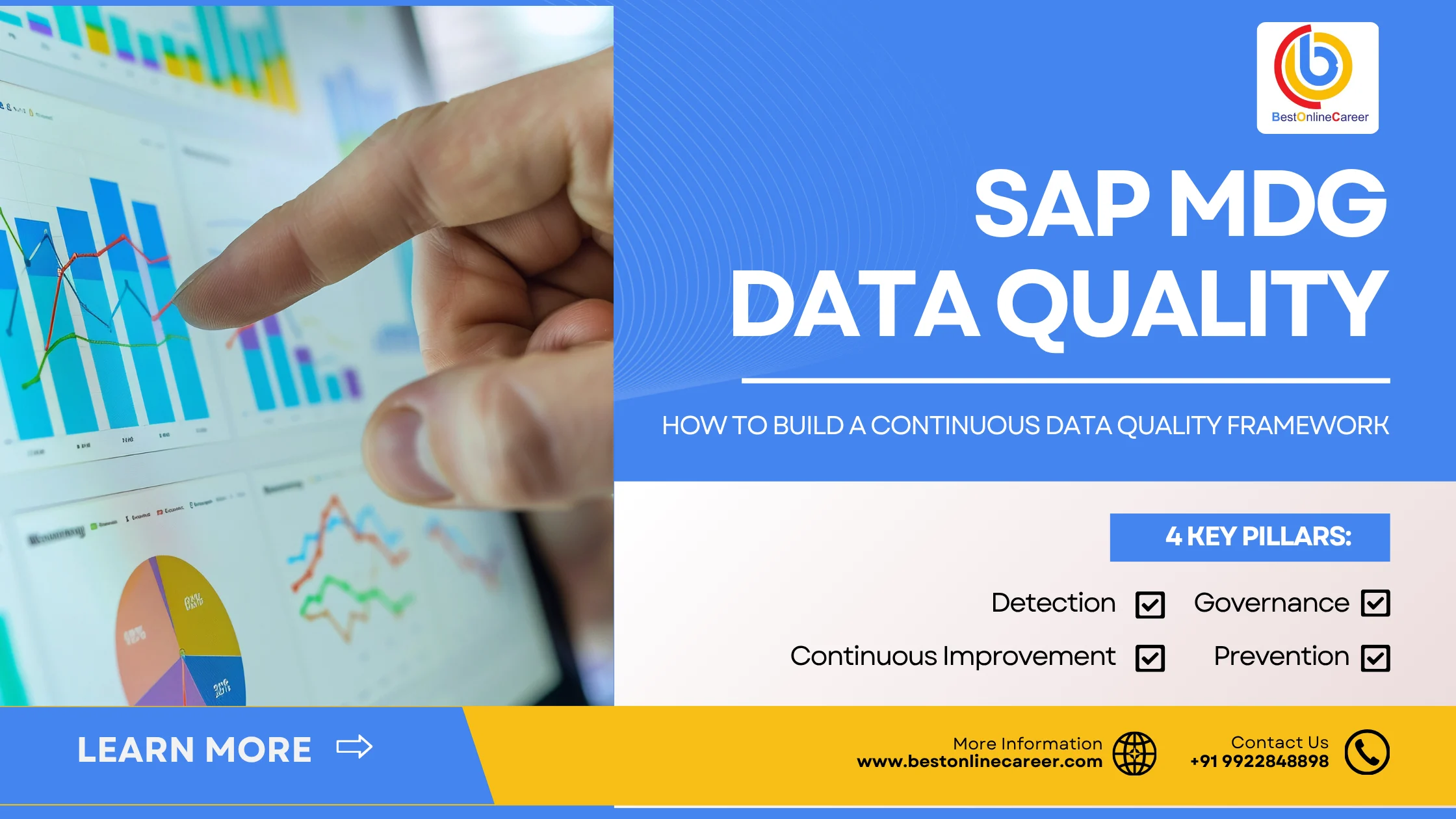
How to Build a Continuous Data Quality Framework in SAP MDG
Many organizations don't suffer from an issue with their data quality due to the fact that they aren't governed by rules. They face problems with data quality because the rules are only enforced at a time -- typically at the time of initial SAP MDG implementation -- but then they slowly fade away as business evolves as new fields are added, and no one revisits their governance framework. Six months after the duplicate vendors have returned as customer records diverge across systems in addition, they are unable to reconcile the "clean data" project from last year must be carried out in a new way.
Continuous data quality framework can fix this by treating quality of data as an ongoing operational process within the SAP Master Data Governance. It is not an one-time clean-up exercise. This guide will explain what it looks like in the real world including the structure of governance as well as the workflow design as well as the mechanics of validation and duplicate-check and the key KPIs and the maintenance schedule which prevents quality from deteriorating once more after going live.
Why "One-Time Clean Data" Projects Fail
Before you build an infrastructure, it's important to knowing why the traditional method doesn't work anymore. A typical project for data cleanup follows the same pattern: evaluate the current quality of data, clean and eliminate duplicate records and load the clean data declare victory. After a year, the quality has declined again and not due to the fact that the cleanup was poorly executed however, because no measures were implemented to stop any new bad data from getting into the system.
Continuous data quality turns this around. instead of asking "how do we clean the data we have," it is "how do we make sure bad data structurally can't enter the system in the first place, and how do we catch what slips through quickly." SAP MDG is built specifically to work with this second model, yet most companies only make use of a tiny fraction of its capabilities.
The Four Pillars of a Continuous Data Quality Framework
A strong framework within SAP MDG rests on four pilings working in tandem. Do not take any of them off and the framework will deteriorate to a single cleanup within the course of a year.
- Governance -transparent ownership, accountability and decision rights over master domains of data
- Preventive -Validation procedures, checks for duplicates along with workflow rules that prevent from creating bad data
- Detection Monitoring that continues along with quality scores that detects the signs of degradation earlier
- Continuously improving A periodic interval of reviewing the KPIs, rules, and processes as the company grows
Pillar 1: Governance -- Defining Ownership Before Touching the Tool
Create a data governance operational model for data governance
Before any configuration or technical change to be made, you must define who is the owner of the data in what. This involves that you identify the master data the owner to each master domain (customer vendor, customer finance, material) and defining whether the governance model is centralized, federated or hybrid. This is a decision that determines how SAP MDG Workflows and authorization concepts are configured in the downstream.
- Governance centralized: A single team is responsible for the the creation and maintenance of an entire domain company. Most consistency, slow response to local business requirements.
- Federated Governance business regions or units keep their own information within a common system that is governed by global standards. Rapider local response, which requires stricter rule enforcement to prevent drift.
- Hybrid Governance The core elements (tax identification number, name legal and global classification of materials) are centrally controlled while the local aspects (regional pricing and compliance fields for local areas) are connected.
Large, multi-entity companies adopt hybrid governance for SAP MDG, because it is able to balance consistency on the fields which are important to reporting and compliance with the reality that local teams require flexibility in operational fields.
Create a data stewardship framework
Assign data Stewards who are responsible for the day-to-day performance within their respective domains review workflow rejections and resolving duplicate suspects and escalating issues with the system. Stewardship of data is often not adequately funded because it appears to be "just approving requests," but stewards are the actual human component of the system. Automated rules spot obvious issues; stewards spot the decisions that automation cannot.
Quality policies for documents and not only technical rules
A governance charter should specify the business language of the definition of "quality" means for each area: which fields must be mandatory, what fields require dual oversight and what the acceptable threshold for duplicates can be and who holds the ultimate approval authority. The document is the point of truth from which the technical setup (validation rules workflows, duplicate checks, validation rules) is built on -- and is the basis for any inquiry about the reason for a rule six months later.
Pillar 2: Prevention -- Configuring SAP MDG to Stop Bad Data at the Source
The majority of organizations spend time and effort during the implementation, but they usually only set it up once and never go back to it again.
Rules of validation and derivation
SAP MDG's rule-based validation (via Business Rules Framework plus, or BRFplus, and derivation/validation rules within the Data Modeling and Process Modeling tools) lets you enforce mandatory fields, format checks, cross-field logic, and business-specific constraints at the point of data entry, not after the fact. A properly designed rule set should include:
- Required field enforcer defined by the scenario (a one-time vendor does not require exactly the same field requirements as an strategic supplier)
- Cross-field checks for consistency (e.g. the country code must match the tax ID format)
- Business-specific derivatives that populate fields automatically by analyzing other values entered and reduce the chance of errors in entry manually
Checks duplicated prior to the creation of checks and not later
SAP MDG's built-in duplicate checking function (often combined to SAP's capabilities for fuzzy searching) should be running prior to the time the creation of a record and flags possible matches for review instead of letting duplicates be formed and cleaned up later. This is among the most leveraged configuration investments within the framework as the duplicate data in master files is one of the largest and difficult-to-reverse quality issues when it's embedded into the transactional history.
Workflow-driven approval and segregation tasks
Multi-step workflows within SAP MDG should route change requests to appropriate approvers depending on the type of change, its financial implications and the sensitivity of the domain. The most critical fields -- bank information as well as tax identifiers and credits terms require two-control (maker-checker) workflows in particular and distinct from attributes with lower risk modifications that may be able to go through single approval paths. This isn't merely a quality control, but it's usually required for compliance and audit purposes.
Central governance for high-risk situations, flexible federation for low-risk
Apply a strict verification and multi-level approval to the fields that are subject to financial, compliance, or reporting risks. Apply a more gentle validation process for fields where speed is important more than central control. treating every field with the same amount of care is among the fastest methods to create an administration framework that is so slow that business users begin seeking solutions.
Pillar 3: Detection -- Monitoring Quality After Records Are Live
Prevention solves most issues but it doesn't solve the majority of problems. Records that were created prior to the framework was in place or was synchronized with external systems and rule gaps that are only discovered later all require constant monitoring.
Dashboards and data quality scoring
SAP MDG supports data quality reporting, which can be further enhanced by SAP Master Data Mass processing and governance consolidation capabilities or integrated into SAP Information Steward for deeper analysis and scorecards. A good quality dashboard monitors according to domains:
- Fullness -- percent of records having all fields required to be filled
- Accuracy -- failure to validate rates with time
- The rate of duplication -Duplicates that have been confirmed after creation to indicate that the rules for prevention need to be tightened
- Timing How fast changes are processed through workflow and compare to the desired SLAs
- Conformity is a cross-system consistency particularly important for businesses who are syncing master information to S/4HANA or Ariba as well as other downstream systems.
Profiling of periodic data
Ready to Start Your Learning Journey?
Join thousands of learners and build your future with expert-led courses and 100% practical training.
Expert Guidance
Learn from industry experts
Trusted & Recognized
Top-rated by learners
Flexible Learning
Online options
Placement Support
Career support & more
Beyond monitoring in real time In addition to real-time monitoring, plan periodic profiling runs (quarterly is a regular interval that go further than dashboard KPIs to identify patterns in the data: Fields that have been filled but have placeholder or poor-quality values and records that are validated but fail to pass business logic checks that were introduced after the records were made, and changes in the way different business units interpret this same field.
Feedback loops from downstream systems
Master data quality issues typically occur downstream first -- for example, a rejected buy order from S/4HANA an invoice that is not matching in Ariba or the rejection of an EDI transaction. The creation of a structured feedback pathway from these systems on the MDG data Stewards, instead of leaving downstream teams to work on bad data, fills an area that MDG monitoring alone could miss.
Pillar 4: Continuous Improvement -- Keeping the Framework Alive
This is the most important pillar that businesses ignore, and that's the reason why "continuous" frameworks quietly become only-once projects.
Cadence for quarterly governance reviews
Establish a regular schedule -that is, quarterly, works for the majority of organizations where IT, data stewards and business stakeholders look over:
- Quality KPIs versus targets, including a discussion of root causes for any decrease
- Validation rules that produce many false positives (a indicator that they're too rigid) or have missing bad patterns in data (a signal that they're loose)
- New fields, new business processes or newly acquired entities require governance rules to encompass these
- Workflow SLA performance, as the slow approval cycle is an indication of users at work beginning to skip the process
Rule tuning is an official, documented procedure
Each change to the validation rule or duplicate check threshold or workflow routing needs to undergo a simple but effective change processdocumented, tested, and shared -- instead of ad-hoc modifications made by those who are most close to BRFplus's configuration for that week. Rule drift that is not documented is one of the ways that governance frameworks lose knowledge in time.
Training refreshes tied to actual errors
Instead of the standard annual refresher classes, you can use your quality dashboard's errors patterns for training. If a particular business unit has a high percentage of failures to validate the same field, that's a gap in training and not necessarily a rule-based gap. Treating it as training first will avoid the need to tighten rules for everyone to solve a localized issue.
Continuous Data Quality Framework: Summary Table
| Pillar | Core Activities | Primary Owner |
|---|---|---|
| Governance | The ownership of the domain, the stewardship model policies and documents | Data governance council/ CDO office |
| Prevention | Checks for duplicates, validation rules approved workflows with tiered approval | MDG configuration team and data Stewards |
| Detection | Q-score, Dashboards, regular profiling and feedback loops downstream | Team of IT/BI data stewards |
| Continuous Improvement | Review of quarterly intervals of rule tuning, specifically designed training | Data Governance Council |
A Practical Rollout Sequence
If you're creating your own framework, rather instead of retrofitting a current MDG implementation, you can follow a sequence that works well is:
- Define the governance structure and model of ownership before you touch configuration - This decision will affect everything that follows
- It is recommended to prioritize one master domain of data (commonly customer and vendor) instead of trying to create the entire framework across all domains at the same time.
- Configure preventive controls -validation rules duplicate checks, tiered workflows -for the domains that are prioritized.
- Create Basic quality dashboards prior to expanding their scope to ensure you have a base to compare improvements against
- Conduct a complete annual review to verify whether the continual improvement process is effective in real life, and then expand to more domains
- Extension to the remaining domains using the lessons in the first domains instead of repeating the same mistakes in full-scale
Common Mistakes That Undermine the Framework
- Over-engineering validation rules prior to the time of launch. Excessive mandatory fields and strict rules force business users to solutions. Start with the most risky fields and gradually expand.
- The idea of treating data stewardship as an occasional afterthought. If nobody has committed time to stewardship workflow approvals are awaited and business users begin seeking shortcuts.
- There is no feedback loop in other systems downstream. Quality problems that occur in S/4HANA Ariba or other reporting tools must be identified as a route towards MDG management, or become fixed locally and over time instead of at the root.
- Not doing the quarterly review in real life. This is the most frequently skipped step in daily operational pressures It's the one that decides whether the framework remains "continuous" or quietly reverts to static.
- Monitoring activity rather than results. Tracking how many workflows were processed doesn't tell you anything about the quality of data that actually improved. KPIs should be able to gauge the accuracy, completeness and trends in duplication rather than only throughput.
Frequently Asked Questions
What does it mean to be the framework for data quality "continuous" rather than one-time?
A continuous framework includes prevention (rules which stop bad data from entering) as well as detection (ongoing monitoring of data after it has been made live) as well as a periodic review cycle that changes rules based on the changes in business. One-time frameworks end after the initial cleaning and configuration, but there is no means to prevent or detect the possibility of further decline.
What which SAP MDG tools are utilized for data quality protection?
Validation and derivation rules are usually configured using BRFplus and MDG's tools for modeling processes and data, while duplicate prevention is a function of MDG's built-in duplicate checking feature typically paired with fuzzy search options to detect near-matches.
When should KPIs for data quality be monitored?
A quarterly governance review is common and is practical for the majority of organizations however high-risk or high volume domains (like master data of vendors that are related to payments processes) could require monitoring on a monthly basis even if formal governance meetings remain each quarter.
Does every master data domain follow an identical governance system?
Not necessarily. A lot of organizations employ centralized governance to high-risk domains, and federated governance to domains where local flexibility in business is more important and employ a hybrid approach instead of a singular approach to each domain.
What's the main reason that continuous data quality frameworks fail following initial installation?
Skipping the continuous improvement pillar, specifically, the regular review schedule that re-tunes rules and trains users based on the actual patterns of error. Without it, the prevention rules gradually drift out of sync with the way that the company actually runs.
Do we require SAP Information Steward in addition to MDG to implement the framework?
Not necessarily to begin. The native SAP validation and duplicate check workflow capabilities are able to support an effective continuous framework on their own. Information Steward can be more beneficial for companies that require more detailed information profiling and cross-system scorecards that are scaled.
Final Word
Continuous data quality framework within SAP MDG isn't a bigger version of a project to clean up data It's a fundamentally different operational model based on prevention, governance and detection, as well as an actual rate of improvements. Companies that view the quality of data as a single SAP MDG milestone are almost certain to return to where they began within an year or two. Companies that construct the four pillars with care beginning with only two or three domains, tend to see improvements in quality grow rather than decline.
If you're trying to build SAP MDG governance and data quality knowledge, or want to enhance your organization's master practices for data, Best Online Career offers SAP MDG Training covering both the technical configuration as well as the governance frameworks that help ensure continuous quality data stick.
Related SAP Training Courses
Tags
Share this article
Help others discover this valuable SAP content