
5 Signs Your Treasury Operations Need SAP TRM
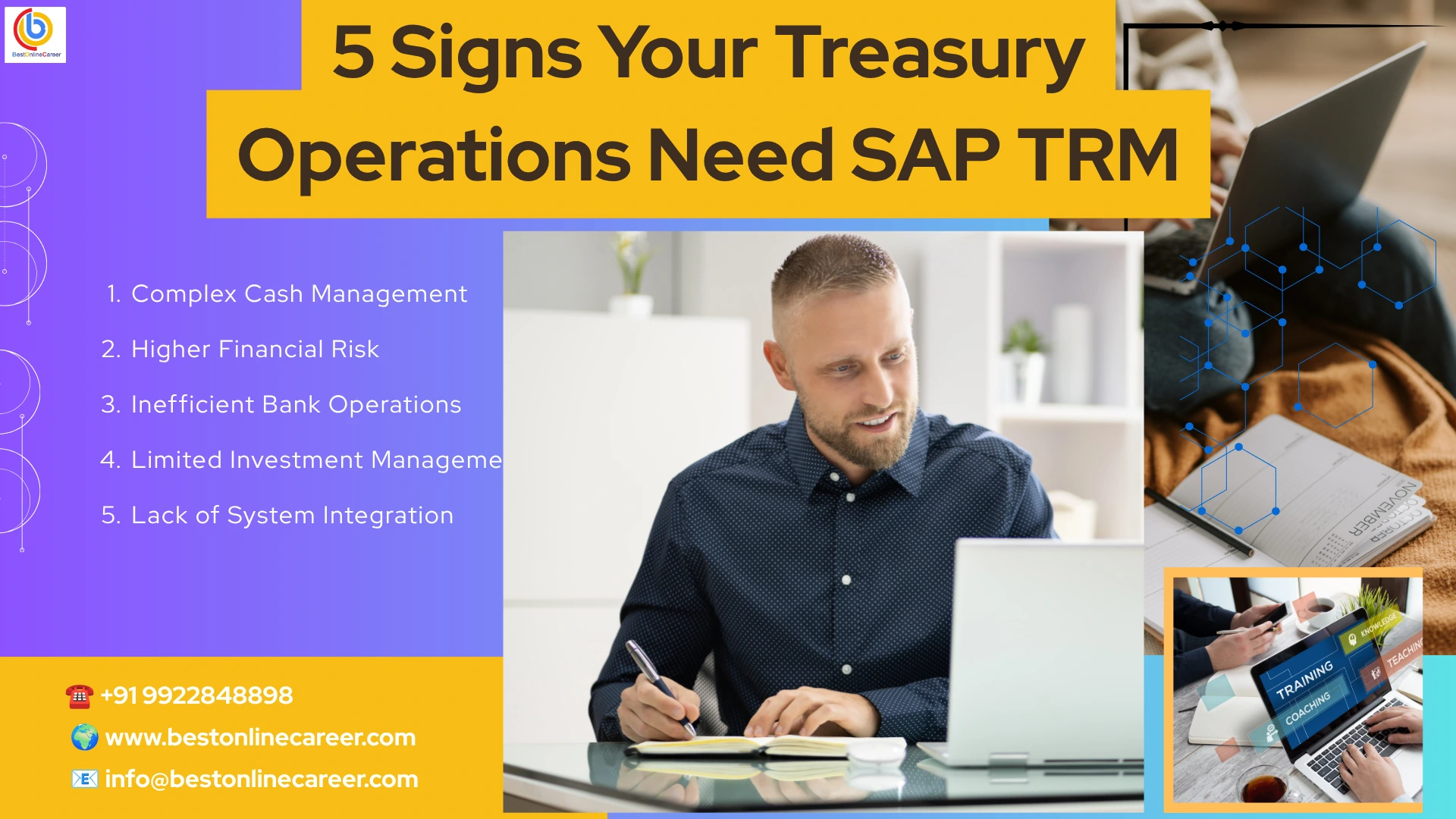
5 Signs You Need SAP TRM in Your Treasury Operations
Treasury operations have long ceased being simply an auxiliary function and became one of the most strategic departments within an organization. The treasury is not only responsible for ensuring payroll clearance or paying vendors timely. Modern treasury staff must be capable of managing the liquidity of the corporation in several currencies, predicting the cash requirements of numerous entities, hedging risks due to the unstable market, meeting accounting and regulatory requirements, and providing management with immediate financial insights. Despite that, some organizations rely on the old-fashioned treasury operations conducted with the help of multiple spreadsheets, emails, and online banking sites. This paper discusses five clear signs that treasury operations have outgrown the available solutions and explains why each of them matters for the organization, as well as demonstrates the way in which SAP Treasury and Risk Management (SAP TRM) can solve these issues.
Quick overview: Poor cash visibility, disorganized financial instruments, hedge accounting stress, unmeasured risk exposure, and disconnected finance systems are the five signs covered below.
Why Treasury Management Can't Stay Manual Forever
There was a time when all that an efficient treasury analyst with a good spreadsheet would need in order to stay on top of his company's cash would be a good set of numbers. Transaction volume was much lower back then, there was usually just one market exposure and much less pressure to be compliant in terms of financial reporting. This reality is definitely not applicable to the majority of mid-size and large companies anymore.
In today's environment treasuries deal with cash of their companies at several banks in several currencies, sometimes even in different jurisdictions and time zones. At the same time they have to actively manage the financial risk instead of only having a post-event review of the situation in terms of financial reporting. They have to predict movements of the interest rate, hedge foreign exchange exposure and generally structure hedges that will protect the business from the impact of market changes. The increasing pressure of compliance requirements like IFRS 9 makes it evident how inefficient manual treasury management has become, which is why more companies are turning to SAP treasury management software to modernize these processes.
The fundamental problem is not about how spreadsheets are inherently bad solutions; instead, the problem lies in the fact that they were never intended to be used for managing at the level that today's treasuries need to manage. One wrong formula, one forgotten update, or one version control problem (such as a user working on an old version) results in decisions being based on incorrect numbers. And as the volume and financial complexity of transactions grow, the likelihood of making those mistakes increases at the same time. There comes a point in the process when the risks and inefficiencies of doing things manually outweigh the costs of using a treasury management solution. The ability to recognize that turning point is what distinguishes good treasuries from bad ones.
1 You Lack Real-Time Visibility Into Cash Positions
The surest and most obvious indication that the treasury department should invest in an upgrade is when it cannot provide a straightforward yet very important piece of information: "What is our current cash position?"
In many cases, it means that somebody should login into multiple bank portals, extract data to an Excel file, do calculations, correct for time differences, pending transactions, currency exchange rate issues and produce a report which can take several hours or even days depending on the number of entities and banks the company works with. And at the moment this report will arrive to decision-makers it can already become outdated. Furthermore, because it was created manually there is a chance that the data included in it contains errors.
Lack of up-to-date information can lead to certain financial losses. For example, a company postpones payment of a debt because it thinks that its cash position is low, missing a chance to save money on interest charges. Or it plans to spend a significant amount of money on capital expenditure thinking that it has enough liquidity only to face a shortfall in the future. It becomes a huge issue for companies with many bank accounts and subsidiaries.
SAP TRM gets around this problem by being integrated with banking systems and ingesting statement data automatically in standardized formats like MT940, BAI2, and camt.053. Rather than downloading statements manually and aggregating the information, all cash positions for every bank connection and entity become available instantly via a single dashboard, giving treasury teams true cash and liquidity management in real time. One of the most labor-intensive activities of treasury operations - bank reconciliation - becomes an automated function at this point. The outcome of this is that the treasury department always has up-to-date knowledge about its global liquidity position, thus making decisions about investment, borrowing, and funding easier and more reliable.
2 Managing Financial Instruments Feels Like Guesswork
However, as a company expands and its finance strategy evolves, a variety of financial instruments that far exceed deposits and loans emerge. A number of foreign exchange transactions, interest rate swaps, bonds, commercial paper, money market instruments, and derivatives used for hedging or investments become part of the company's operations. Every type of instrument is associated with a set of conditions, valuation, settlement, and risk specifics.
However, when such a portfolio of instruments is managed through manual means and consists of various spreadsheets created and maintained by different individuals, it is impossible to keep track of everything. Maturity date may go unnoticed, valuation can be out-of-date, or terms of a derivative can be recorded wrong. Such oversights are not merely a nuisance but also represent a financial risk. Failure to settle a swap can generate additional costs or cause damage to the company's reputation among its counterparties. Out-of-date valuation will affect financial reports and attract the attention of the auditors.
It is the very problem that is intended to be solved by SAP TRM's Transaction Manager application. It is designed as a central system of record where all financial instruments belonging to the organization will be registered, valued and managed - from money market instruments, to foreign exchange transactions, derivatives and securities. The deal capturing, life-cycle management and automatic valuation will be conducted systematically rather than being done manually, making SAP Transaction Manager a core part of any financial instruments management strategy. This means that treasurers will not depend on their own memories, scattered spreadsheets and corporate lore regarding the very instruments the company has, their value and when the actions should be taken.
3 You Are Struggling with Hedge Accounting and Compliance
Hedge accounting is often considered to be one of the most complicated areas of corporate finance, and rightfully so. For example, accounting standards like IFRS 9 impose a series of strict requirements for applying hedge accounting, which include rigorous documentation of the hedging relationship at the start, as well as effectiveness assessment to show that the hedging activity still works as intended. Finally, ineffectiveness needs to be properly disclosed, and all this has to be done manually - often retroactively via emails and spreadsheets at quarter end.
However, the same issue often leaves many treasury and accounting departments struggling with stress in every reporting period, trying to gather all necessary documents and effectiveness testing needed to demonstrate hedge accounting. In case if there is no sufficient documentation or if it fails to provide effectiveness testing results, it leads to the necessity to reclassify gain/loss through the income statement, which can cause additional fluctuations in reported earnings and concerns on the side of auditors, investors, or even regulators. The fact that hedge accounting is performed in such a reactive way indicates that the entire process should be automated.
It is exactly what SAP Treasury and Risk Management does. The system automates the hedge accounting process by integrating it with the transaction life cycle instead of implementing it manually. It creates hedge accounting documentation automatically and performs effectiveness testing of the process. SAP supports all the main standards of hedge accounting, so the platform was developed with taking them into account, offering built-in IFRS 9 compliance as part of its core design. Thus, it greatly minimizes the possibility of audit findings, helps to avoid additional efforts during reporting periods, and provides much more confidence about the validity of hedge accounting positions.
4 The Risks Your Organization Takes Are Not Being Quantified Accurately
The inability of a treasury function to accurately measure its risk exposure to market and counterparty risk implies that the treasury function has a major blind spot in place. The fact that it is difficult for your team to answer questions such as "How much risk do we have regarding a sharp increase in interest rates?" and "Which of our counterparties present the highest credit risk when they fail?" implies that you are dealing with a serious problem in measuring your risks.
In case there are no advanced risk analytics tools within your organization, you may develop risk exposures slowly and without realizing that. For example, an organization may become exposed to a high degree of interest rate risk as a result of a series of loans and derivatives that by themselves would not imply any problems, but their overall effect is rather risky. Likewise, concentration risk with respect to a particular counterparty may not become visible only when that counterparty has financial problems. Such surprises tend to be costly to organizations and even threaten their stability in some cases.
As a module of SAP TRM, the SAP Risk Analyzer is designed with the sole purpose of addressing this issue. It offers treasury teams sophisticated means of continuously measuring and monitoring risks, including Value-at-Risk (VaR) measures that quantify possible losses resulting from various market scenarios, analysis of credit risk of each particular counterparty, as well as automatic monitoring of the level of exposure relative to defined risk limits. Instead of identifying the issue once it occurs, the system raises alarms whenever the exposure reaches certain levels and needs to be addressed. In effect, this turns financial risk management into a proactive rather than reactive effort.
Treasury Operations Remain Siloed from Finance and ERP
Another indicator that treasury operations may require modernization is their disconnection from the wider finance and ERP environment. In practice, such a situation can take many different forms but usually starts with something as simple as a transaction completed in treasury that needs to be manually entered again into the accounting ledger. The result of such disconnection is that neither treasury nor finance can see what each other is doing.
This kind of fragmented approach causes many other related issues. First, there is always a risk of data entry mistakes caused by the need for transferring information manually from one system to another. Second, it increases the time required to perform month-end and quarter-end closing procedures, as additional time is needed for reconciliation between treasury accounts and general ledger in order to find any discrepancies. And third, which is perhaps the most important issue, it makes it impossible for the company to have a single integrated view of its finances, as treasury and finance will have different views on the same reality.
Unlike other treasury management solutions, SAP TRM is built to solve this problem in an elegant way by integrating natively with SAP FI/CO and, in case of modern solutions, with SAP S/4HANA Finance. It means that transactions performed by the treasury department, such as loan drawing, foreign exchange transaction or valuation of derivatives, are automatically reflected in the financial accounting system without any need for manual data entering.
Advantages of Straight-Through Processing (STP)
One of the most valuable outcomes derived from increased integration of treasury with the larger ERP picture is something called straight-through processing or STP. Straight-through processing is a description of a process where a transaction goes through the complete sequence from inception of the transaction to its confirmation, valuation, settlement, and accounting posting in a fully automated fashion without any manual steps required at any stage.
In other words: take a foreign exchange transaction carried out by the treasury trader in question. In the manual setting such a transaction may require entry into the trading system, re-entry into the treasury spreadsheet and finally re-entry into the accounting system where it is to be posted. With the help of SAP TRM and straight-through processing the same foreign exchange transaction is entered just once, valued using the latest market information, confirmed with the counterparty and posted to the general ledger without any manual re-entry.
Beyond the obvious advantages of saving time, the advantages of STP go much further, although this is a very tangible advantage by itself. With STP, operational risks involved with manual data entry are greatly reduced, due to the fact that there is much less chance for transcription mistakes and mismatches of data entered into the systems. In addition, STP provides constant consistency of the financial data across the entire organization, since all of the systems work with the automatically produced source data, which is entered in only one place, not several ones. Companies that manage to successfully introduce STP as part of the SAP TRM implementation, powered by treasury automation software, often report considerable decreases in processing time and error rate, as well as treasury teams able to dedicate more time to strategic activities than to routine administrative processes.
How to Get Started with SAP TRM Implementation
If you are experiencing any of these warning signs in your organization, it is an essential step to take before going any further, but it is important to realize what exactly takes place during the SAP TRM implementation process.
Implementation always starts with an evaluation phase, where current processes, the current systems used, and the particular problems are thoroughly assessed and documented. Based on the findings in this phase, it will become clear what the implementation scope is. While some companies prefer to implement all of SAP TRM's capabilities right from the start (cash management, transaction management, risk analytics, hedge accounting), other organizations decide to go with a phased approach where the initial implementation scope starts with one particular pain point (for example, lack of cash visibility or hedge accounting problems) and gradually increases from there.
After the scoping phase, the system configuration phase follows, where SAP TRM is configured according to the particular entity structure, banking structure, type of instruments used and reporting requirements. Data migration is another key step in this phase, since historical transactions, instruments and counterparties need to be imported from the legacy systems. Integration work is necessary to integrate SAP TRM with the company's ERP system(s), banking systems and third party data providers of market rates/risk data.
Prior to go-live, comprehensive testing is critical to ensure that there is correct data flow, appropriate valuation and correct reporting results. However, change management and training of users is also crucial during this process, as treasury professionals need to move from their usual manual processes to an environment where things are more automated. Although this change is necessary and will be helpful for the company in the long run, it does involve some adjustments to be made. To minimize possible issues and stay on schedule, companies often turn to external experts specialized in SAP TRM implementation.
| Implementation Phase | Key Activities |
|---|---|
| Assessment | Review current treasury processes, systems, and pain points |
| Scoping | Define full or phased rollout across cash, transaction, risk, and hedge modules |
| Configuration | Set up entity structure, banking connections, instrument types, and reporting |
| Data Migration | Transfer historical transactions, instruments, and counterparty data |
| Integration | Connect SAP TRM with ERP, banking systems, and market data providers |
| Testing & Go-Live | Validate data flow, valuations, and reporting before full deployment |
Built-in Support for Compliance with Regulations
It is important to note that compliance and regulation have been built into the core of the SAP TRM solution. Standards such as IFRS 9 and others that regulate financial risks reporting are directly incorporated into the processes of hedge accounting and risk management.
Such a built-in regulatory alignment is extremely important in the context of treasury and finance teams, as this implies that the compliance is not an afterthought and does not need to be implemented into the platform manually, but becomes a part of transaction capturing, documentation, and reporting from the very beginning. As accounting standards and regulatory requirements change over time, a platform which is regularly updated and aligned with these changes greatly simplifies the process of tracking these changes and implementing them into the platform for the internal team. In other words, such compliance will help to stay always ready for auditing, instead of preparing for it just a few weeks before the audit is scheduled.
Talk to Our SAP TRM Experts
If you recognize in your organization one, two, or even all five of these signs, it clearly means that the moment to talk about SAP TRM has come. Every treasury function is unique: it depends on the size of the company, industry, geographical location, types of financial instruments, etc.
Our team of experts with SAP TRM has extensive experience analyzing the current treasury processes, pinpointing the exact areas where the biggest gaps and risks exist, and creating a realistic map that will lead you to a treasury process that is automated, precise, and takes risks into account. Whether you struggle with visibility of the cash process, have problems with implementing hedge accounting practices, or simply want to upgrade the old system with a modern SAP treasury risk management solution - we can provide you with insight on how implementation of SAP TRM will work for you.
Contact us right now to schedule a consultation and make the first step in changing the way you control your treasury.
contact ">Schedule a ConsultationRelated SAP Training Courses
Tags
Share this article
Help others discover this valuable SAP content


